 [Ruins of the Tower House of Grangebegg, Borris-in-Ossory, Queen's County, Ireland, 2004.]
"In Disert did inhabit a peremptory, bold companion, Sir John PIGOTT, a captain of foot before these commotions, confiding too much in the strength of his castle, in the number of his men, in the abundance of both provision and ammunition, and in his own supposed skill, and also in the ancient friendship of the house of Tyrone (whereof he was fosterer by his mother's side of the OVENTONs) would not by any means surrender, either for friendship or in intimation of the rest, though severally attempted by noble messengers, and honorable quarter of life, goods, arms and castle, only to swear fealty to King and country.
"Shewing himself so stiff-necked, the Catholic General (though his well-wisher) grew mighty descontented, commanded Colonel O'FARRELL and Colonel Roger McGUIRE's regiments to take that Castle..."
[Report of the 1646 "Aphorismal Discovery, Volume 1," and cited by Michael CAREY in his "History of the Queen's County," 1857.]
Whether John PIGOTT, formerly of Grangebegg, had entered into "negotiations" with his besiegers, or whether his brother-in-law Barnaby O'DUNNE had, fearing the worst, made his escape by breaching his relation's terms and opening the door to the ensuing attack, we may never know. But we do know that PIGOTT was killed, along with his youngest son William, and some 40 or more other members of the garrisoned estate.
The date was 6 October 1646, and the King, to whom John had been loyal at the outbreak of the Catholic Rebellion in October 1641, had lost his support by actively seeking Irish Catholic reinforcements to his own depleted Army in England. John had laid down his arms at the Cessation negotiated in September 1643.
The women folk, including his widow Martha and several of their daughters, although witnesses to the atrocities, were, under O'NEILL's own instructions, allowed to go unmolested, despite being stripped naked, in a move probably designed to winkle out those men who had allegedly disguised their gender under women's attire.
John's naked body, genitally mutilated, lay unburied for some time in the ditch where it was thrown.
John was the eldest son and heir of Sir Robert PIGOTT (1565-1642) of Dysart, Queen's County, by his first wife Anne ST LEGER (she died in 1599) - they were probably married in late 1590 or early 1591. He was probably born in Dysart, about 1591. His father, created a Knight in 1609 for his part in the clearing of the O'MOREs out of the County (see his separate post in this blog), had probably begun handing over the running of the Dysart estate as early as March 1639 - John recorded his residence there when re-elected as the Member for the Queen's County in the Irish Parliament. John's earlier election, in July 1634, had recorded him as residing at Grangebegg, an imposing tower house in Borris-in-Ossory, the ruins of which are still standing (see attached photograph above).
John's early career is overshadowed by that of his father. He was about 8 when his mother died, and from about 1602-03, he was raised by his step-mother, Thomasine PIGOTT (the widow CASTILLION, born PEYTON), along with his five surviving blood-siblings, his two CASTILLION step-siblings (which included Catherine, the mother of his future daughter-in-law), to which number was added another five half-siblings from his father's second marriage.

[Sir Thomas COLCLOUGH of Tinterne Abbey, County Wexford.
Image courtesy of John COLCLOUGH's blog-page at www.colclough-resource.blogspot.com.au.]
John himself was married to Martha COLCLOUGH, a daughter of Sir Thomas COLCLOUGH (1564-1624) of Tynterne, County Wexford, by his spouse Martha LOFTUS (died 1609), a daughter of Adam LOFTUS, Archbishop of Dublin, and Jane PURDON.
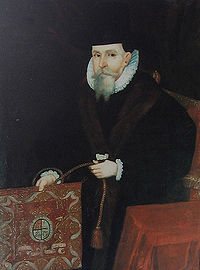
[Rev Adam LOFTUS, about 1533 - 1605; Archbishop of Dublin.]
Sir Thomas COLCLOUGH was in turn a son of Anthony COLCLOUGH (about 1549 - 1584) by his wife Clare AGARD, a daughter of Thomas AGARD of Foston, Derbyshire, and a sister of Francis AGARD, a Councillor of Ireland.
We have no particulars of John and Martha's marriage, which probably occurred about the time John came of age, around 1612.
Sir Thomas died in August 1624, and details of his family are recorded in one of CROSSLE's Abstracts [Findmypast], as follows:
"Sir Thomas COLCLOUGH, of Tinterne, Co Wexford, Knt. Dec'd 23 August 1624; married Martha dau of Ad: LOFTUS, L'd Archb'p of Dublin, and had issue:
Adam.
Joh:
Rich:
Anna (1); married 1, Nich: BAGENALL.
married 2, Thomas BUTLER of Cloughrenan, County Carlow.
Martha (2); married Jo: fil. Rob: PIGOTT de Disert, Knt.
Jone (3); married Jo: OWGAN of ..., Wales, Esq.
Mary (4): married Sir Nich: WALSH ye younger, Knt.
Elen (5); married Brien CAVANAH of Polmonte.
"Sir Thomas's second wife was Elin'r, dau of Dudley BAGENALL; with further issue:
Dudley.
Mabel."
And there were ten known children of the marriage, who were probably raised at Grangebegg:
1. Robert PIGOTT, the eldest son, probably born about 1612-13; the heir apparent to Dysart; possibly the Mr Robert PIGOTT (unless instead his father's younger half-brother) referred to by Samuel FRANCK of Dernesharagh, Queen's County, in his Deposition dated 1 February 1643, as being the Governor of Castle Burrowes (Borris-in-Ossory), Queen's County, during the siege led by Florence FITZPATRICK, the rebel Lord of Upper Ossory (who had been dispossessed of the castle by the grant of it to George VILLIERS, Duke of Buckingham, by James I); Walter DISCHOME, in his Deposition dated 11 April 1642, mentioned that his Irish wife, bred a Protestant, was employed to carry letters, and "...was employed in a second service by Sir William GILBERT (governor of Mary Burrow and the fort there) to go to Captain PIGGOTT's wife at Burridge who he had heard was so hard beset that shee was like to give up the castle there; but upon Sir William GILBERT's letter, she, though much bestraited for victuals, kept the castle safe from the rebels" [Manuscript 815, folios 186 recto - 187 verso]; if so, it was his daughter Ann to whom Sir William GILBERT wrote, evidently recently married to Robert PIGOTT; and if so, it was his father, John PIGOTT, who led a troop of English to relieve it for the second time (some months after Sir Charles COOTE's first relief at Easter, 1642).
Robert was reported to have been killed at the fall of the Fort of Maryborough (of which his father-in-law, Sir William GILBERT, was governor), in September 1646, about a week before the sack and storm of Dysart [letter of his brother Thomas PIGOTT published in the Egmont Manuscripts].
Robert was married to Anne GILBERT, daughter of Sir William GILBERT (died in 1654) of Kilminchey, Queen's County, by his spouse Catherine CASTILLION (John's step-sister); she evidently died in or before 1654, and possibly before the Sack of Dysart in October 1646; they had issue two children, who were probably living with their PIGOTT grandmother at Dysart in October 1646, and were living as orphans in 1654, one of whom was:
a. Thomas PIGOTT, probably born about 1641-42; he witnessed his grandfather's death at Dysart, October 1646, and died at Dysart in 1702), the heir to Dysart; married in Dublin, 1663, to Elizabeth WELDON, with issue.
2. Thomas PIGOTT; probably born about 1614-15; admitted Scholar at Trinity College, Dublin, 11 September 1629, a native, restored 19 November 1634 (age not recorded, but presumed to have been 14 or over), B.A. 1634 [Alumni Dublinenses]; an Army Colonel, he went to England during Civil War, firstly in November 1641, and again in October 1643, when he remained there, eventually settling at Brockley Park, Somerset; he was appointed Master of the Court of Wards and Liveries in Ireland under Charles II; he was buried at Long Ashton Parish Church, near Bristol, 10 January 1673-74.
Thomas was married, perhaps secondly (although no evidence has yet been found to support a notion that he may have had an earlier wife), about 1644 (probably some time between October 1643 and January 1645), to Florence SMYTH, the widow of Thomas SMYTH of Long Ashton, Somerset (he was buried there on 21 October 1642, and his last child by Florence was baptized on 6 April 1643), and daughter of John, Lord POULET of Hinton St George, Somerset; Florence PIGOTT was buried in the SMYTH family vault, under the Chancel in Long Ashton Parish Church, on 8 November 1676; they had issue:
a. Martha PIGOTT, baptised at Long Ashton, 2 October 1645; she died in September 1682, and was buried at St Audoen's (C.of I.), Dublin, 31 September; she was married at Long Ashton, 31 December 1663, to Christopher USSHER, Esq, of Bridgfoot; he died in 1706, aged 72, and was buried at St Audoen's, Dublin, 10 June; with issue, including:
i. Florence USSHER, baptised at Long Ashton, 2 February 1665-66; buried there on 28 June 1668.
ii. Catherine USSHER, baptisee at Long Ashton, 18 October 1667; buried there on 12 May 1669.
iii. Elizabeth USSHER, born in 1674; buried at St Audoen's, Dublin, 23 December 1675.
iii. William USSHER, baptised at St Audoen's, Dublin, 19 November 1675; of Ussher's Quay, Dublin; M.P. for Limavady; died in 1719; he was married in 1695, toLettice WADDINGTON, with issue.
iv. Martha USSHER, baptised at St Audoen's, Dublin, 17 July 1677.
v. Florence USSHER, born in 1678; buried at St Audoen's, Dublin, 3 October 1682.
b. Paulet PIGOTT, baptised at Long Ashton, 29 October 1646; buried there, 12 February 1646-47, aged 3 mos.
c. Paulet PIGOTT, baptised at Long Ashton, 2 December 1647; buried there, 26 November 1673, aged 15.
d. John PIGOTT, baptised at Long Ashton, 3 January 1648-49; of Brockley, and The Grange, Weston, both in Somerset; he died on 23 December 1727 - "Bristol... The Hon Coll John PIGGOT, son of the Hon Coll Thomas PIGGOT, Master of the Court of Wards in the Kingdom of Ireland, died the 23rd, aged 80, and was interred last Thursday. He was a Seaman and a Soldier in the Reign of K.Ch.II, an early man of the Revolution, a steady Friend of the House of Hanover and a bold Asserter of the Liberties of his Country" [The Daily Journal, Thursday 4 January 1728]; he was buried at St Nicholas's Church, Brockley, Somerset, on 28 December 1727; he was married (his wife has not yet been identified), perhaps in Ireland (no appropriate PIGOTT marriage have been found in Somerset parish records), with issue:
i. Florence PIGOTT; probably born in or before 1692; she was married at Brockley, 1 June 1710, to Anthony BIGGS, Gent, of Bath, with issue including a son John BIGGS, who adopted the PIGOTT surname, and was buried at Brockley Church, 13 January 1795, aged 84 (having married Anna COWARD, died in 1810, with issue).
ii. John PIGOTT; High Sheriff of Somerset; inherited Brockley from his father; he died on 14 April 1730 - "On Saturday died John PIGOTT, of Brockley, Esq, High Sheriff of the County of Somerset, of the Gaol distemper, which he caught the last Assizes. He married a sister of Sir John SMITH of Long Ashton in that County" [Daily Journal, London, Saturday 18 April 1730]; he was buried at Brockley Church, 20 April, s.p.; the Brockley estate went to his nephew John BIGGS, who adopted the surname PIGOTT; he married on 15 February 1728, Florence SMYTH (she remarried Sir Jarret SMYTH).
e. Elizabeth PIGOTT, baptised at Long Ashton, 13 July 1650; she was married to Mr LONG of Bristol.
f. Thomas PIGOTT, baptised at Long Ashton, 27 November 1651; buried there on 17 December 1651.
3. Alexander PIGOTT; of Innishannon, County Cork; served with distinction in the Earl of Inchiquin's Regiment, Civil War; Lieutenant-Colonel in the Army; his will, dated 1680, was proved in 1683; he was married to Ann ADERLEY, the widow of Thomas ADERLY, and the daughter of Sir Edward BOLTON of Brazil, County Dublin, with issue.
Ancestor of the PIGOTTs of Chetwynd, County Cork, of Loughrea, County Galway, and the Baronets of Knapton.
4. John PIGOTT, probably born about 1627 +/- 3 years, fourth and youngest surviving son of John PIGOTT of Grangebegg and Dysart, Queen's County, by Martha COLCLOUGH; of Raheenduff, Barony of Stradbally, Queen's County, Gent, "Census" of 1659; Commissioner of Poll Money Ordinance, 1660-61; possibly the Army Lieutenant serving under Colonel Thomas PIGOTT (? his uncle), 1662; probably the Captain PIGOTT named in CARTE MS 36, dated at Kilkenny, 6 May 1663, being a letter from Robert SMITH to Lord ORMONDE - "States the reasons of a suspension, until notification of the Lord Lieutenant's further pleasure, of proceedings under a certain certificate (from Sir Allan BRODERICK, Surveyor-General) for putting Captain PIGOTT into possession of a house in Kilkenny, as being a fortified house, which house, adds the writer, was '... for many thousand other estates surveyed as forfeited, in the time of the Usurper, and since... legally put out of charge in His Majesty's Court of Exchequer'..."; probably named in a "List of Loyal Officers... now in Mounster," 28 May 1664, as Capt John PIGGETT [CARTE MSs, Volume 59, Page 35, Bodleian
Library], although it is unclear why he was in Munster; ORMONDE made a grant to Christopher GRANT and Henry BRERETON for "...recovery of debts from Capt John PIGOTT, a military officer of Rahineduff, Queen's County," 25 November 1664; named in ORMONDE's grant to George PEYTON and Thomasin his wife (formerly a PIGOTT, and John's step-aunt) in the "...recovery from Capt John PIGOTT of rents in Queen's County," 6 February 1664-65; CARTE MS 42, dated at Kilminshy, 13 September 1665, from Lord INCHIQUIN to LANE, "... accredits Capt John PIGOTT, who has matters of military detail relating to the Army in Ireland, to submit to he Duke of Ormonde"; ordered, on 15 November 1565, "... to inform himself concerning the allegations of the within petition, and finding them true, to admit the petitioner to the place he desires in the foot company under his command upon the first vacancy that shall be therein"; Captain, over Ensign Chidley PIGOTT (a half-cousin) who removed, 27 January 1666, and was replaced as Ensign by Francis GRAHAM (perhaps the foregoing and un-named petitioner). John PIGOTT appears to have come into possession of the Townlands of Bonachrie, otherwise Bannagherry, in the parish of Erk, Barony of Upper Ossory, Queen's County, which was later in the possession of his son and grandson, both named Thomas PIGOTT; the Deeds associated with Bonachrie cite a Lease dated 29 May 1663, whereby Teighe DUN, his wife Esme formerly KEAS (? or KEYES) and Grizel KEAS, leased the lands to John BASKERVILLE for 999 years at the rent of one peppercorn if asked for (the DUNs were probably related to Barnaby DUNN, second husband of John's aunt Elizabeth COSBY alias PIGOTT).
John PIGOTT of Rahineduff died intestate, 1668 - Herald's Escutcheons recorded without date, between two other funerals dated 30 January and 20 February 1688 (possibly 1688-89) [Funeral Entry, Genealogical Office, Kildare Street, Dublin]; Administration granted 26 June 1669 [Wills and Grants, 1669, Ref 12/13/30]; as John PIGOTT of Rahineduff, Queen's County, Esq, his Administration grant, dated 26 June 1669, to John MOORE, Archdeacon of Cloyne, next-of-kin [BETHAM's Abstract]. John PIGOTT was married at Dysart, about 1654 [I.G.I.], to Mary MOORE alias EDGEWORTH, widow of Pierce MOORE of Rahineduff, and daughter of Francis EDGEWORTH of Edgeworthstown, County Longford, by his wife Jane TUITE; the Venerable John MOORE, Archdeacon of Cloyne (who was granted Administration of John PIGOTT's effects in 1669 - see above), was married in 1675 to Jane WELDON, a sister of Elizabeth WELDON, the wife of Thomas PIGOTT of Dysart (they were married in April 1663), and a Rev Francis MOORE, of Rahineduff, was married to yet another sister, Catherine WELDON (all three daughters of William WELDON of Rahinederry, Queen's County, by his first wife Elizabeth ROBINSON, and their eldest son was Walter WELDON of Rosscomroe and Gurteen).
John and Mary had issue:
Sir Thomas died in August 1624, and details of his family are recorded in one of CROSSLE's Abstracts [Findmypast], as follows:
"Sir Thomas COLCLOUGH, of Tinterne, Co Wexford, Knt. Dec'd 23 August 1624; married Martha dau of Ad: LOFTUS, L'd Archb'p of Dublin, and had issue:
Adam.
Joh:
Rich:
Anna (1); married 1, Nich: BAGENALL.
married 2, Thomas BUTLER of Cloughrenan, County Carlow.
Martha (2); married Jo: fil. Rob: PIGOTT de Disert, Knt.
Jone (3); married Jo: OWGAN of ..., Wales, Esq.
Mary (4): married Sir Nich: WALSH ye younger, Knt.
Elen (5); married Brien CAVANAH of Polmonte.
"Sir Thomas's second wife was Elin'r, dau of Dudley BAGENALL; with further issue:
Dudley.
Mabel."
_ _ _ _ _ _ _ _ _ _ _ _ _ _ _ _ _ _ _ _ _ _ _ _ _ _ _ _ _
And there were ten known children of the marriage, who were probably raised at Grangebegg:
1. Robert PIGOTT, the eldest son, probably born about 1612-13; the heir apparent to Dysart; possibly the Mr Robert PIGOTT (unless instead his father's younger half-brother) referred to by Samuel FRANCK of Dernesharagh, Queen's County, in his Deposition dated 1 February 1643, as being the Governor of Castle Burrowes (Borris-in-Ossory), Queen's County, during the siege led by Florence FITZPATRICK, the rebel Lord of Upper Ossory (who had been dispossessed of the castle by the grant of it to George VILLIERS, Duke of Buckingham, by James I); Walter DISCHOME, in his Deposition dated 11 April 1642, mentioned that his Irish wife, bred a Protestant, was employed to carry letters, and "...was employed in a second service by Sir William GILBERT (governor of Mary Burrow and the fort there) to go to Captain PIGGOTT's wife at Burridge who he had heard was so hard beset that shee was like to give up the castle there; but upon Sir William GILBERT's letter, she, though much bestraited for victuals, kept the castle safe from the rebels" [Manuscript 815, folios 186 recto - 187 verso]; if so, it was his daughter Ann to whom Sir William GILBERT wrote, evidently recently married to Robert PIGOTT; and if so, it was his father, John PIGOTT, who led a troop of English to relieve it for the second time (some months after Sir Charles COOTE's first relief at Easter, 1642).
Robert was reported to have been killed at the fall of the Fort of Maryborough (of which his father-in-law, Sir William GILBERT, was governor), in September 1646, about a week before the sack and storm of Dysart [letter of his brother Thomas PIGOTT published in the Egmont Manuscripts].
Robert was married to Anne GILBERT, daughter of Sir William GILBERT (died in 1654) of Kilminchey, Queen's County, by his spouse Catherine CASTILLION (John's step-sister); she evidently died in or before 1654, and possibly before the Sack of Dysart in October 1646; they had issue two children, who were probably living with their PIGOTT grandmother at Dysart in October 1646, and were living as orphans in 1654, one of whom was:
a. Thomas PIGOTT, probably born about 1641-42; he witnessed his grandfather's death at Dysart, October 1646, and died at Dysart in 1702), the heir to Dysart; married in Dublin, 1663, to Elizabeth WELDON, with issue.
2. Thomas PIGOTT; probably born about 1614-15; admitted Scholar at Trinity College, Dublin, 11 September 1629, a native, restored 19 November 1634 (age not recorded, but presumed to have been 14 or over), B.A. 1634 [Alumni Dublinenses]; an Army Colonel, he went to England during Civil War, firstly in November 1641, and again in October 1643, when he remained there, eventually settling at Brockley Park, Somerset; he was appointed Master of the Court of Wards and Liveries in Ireland under Charles II; he was buried at Long Ashton Parish Church, near Bristol, 10 January 1673-74.
Thomas was married, perhaps secondly (although no evidence has yet been found to support a notion that he may have had an earlier wife), about 1644 (probably some time between October 1643 and January 1645), to Florence SMYTH, the widow of Thomas SMYTH of Long Ashton, Somerset (he was buried there on 21 October 1642, and his last child by Florence was baptized on 6 April 1643), and daughter of John, Lord POULET of Hinton St George, Somerset; Florence PIGOTT was buried in the SMYTH family vault, under the Chancel in Long Ashton Parish Church, on 8 November 1676; they had issue:
a. Martha PIGOTT, baptised at Long Ashton, 2 October 1645; she died in September 1682, and was buried at St Audoen's (C.of I.), Dublin, 31 September; she was married at Long Ashton, 31 December 1663, to Christopher USSHER, Esq, of Bridgfoot; he died in 1706, aged 72, and was buried at St Audoen's, Dublin, 10 June; with issue, including:
i. Florence USSHER, baptised at Long Ashton, 2 February 1665-66; buried there on 28 June 1668.
ii. Catherine USSHER, baptisee at Long Ashton, 18 October 1667; buried there on 12 May 1669.
iii. Elizabeth USSHER, born in 1674; buried at St Audoen's, Dublin, 23 December 1675.
iii. William USSHER, baptised at St Audoen's, Dublin, 19 November 1675; of Ussher's Quay, Dublin; M.P. for Limavady; died in 1719; he was married in 1695, toLettice WADDINGTON, with issue.
iv. Martha USSHER, baptised at St Audoen's, Dublin, 17 July 1677.
v. Florence USSHER, born in 1678; buried at St Audoen's, Dublin, 3 October 1682.
b. Paulet PIGOTT, baptised at Long Ashton, 29 October 1646; buried there, 12 February 1646-47, aged 3 mos.
c. Paulet PIGOTT, baptised at Long Ashton, 2 December 1647; buried there, 26 November 1673, aged 15.
d. John PIGOTT, baptised at Long Ashton, 3 January 1648-49; of Brockley, and The Grange, Weston, both in Somerset; he died on 23 December 1727 - "Bristol... The Hon Coll John PIGGOT, son of the Hon Coll Thomas PIGGOT, Master of the Court of Wards in the Kingdom of Ireland, died the 23rd, aged 80, and was interred last Thursday. He was a Seaman and a Soldier in the Reign of K.Ch.II, an early man of the Revolution, a steady Friend of the House of Hanover and a bold Asserter of the Liberties of his Country" [The Daily Journal, Thursday 4 January 1728]; he was buried at St Nicholas's Church, Brockley, Somerset, on 28 December 1727; he was married (his wife has not yet been identified), perhaps in Ireland (no appropriate PIGOTT marriage have been found in Somerset parish records), with issue:
i. Florence PIGOTT; probably born in or before 1692; she was married at Brockley, 1 June 1710, to Anthony BIGGS, Gent, of Bath, with issue including a son John BIGGS, who adopted the PIGOTT surname, and was buried at Brockley Church, 13 January 1795, aged 84 (having married Anna COWARD, died in 1810, with issue).
ii. John PIGOTT; High Sheriff of Somerset; inherited Brockley from his father; he died on 14 April 1730 - "On Saturday died John PIGOTT, of Brockley, Esq, High Sheriff of the County of Somerset, of the Gaol distemper, which he caught the last Assizes. He married a sister of Sir John SMITH of Long Ashton in that County" [Daily Journal, London, Saturday 18 April 1730]; he was buried at Brockley Church, 20 April, s.p.; the Brockley estate went to his nephew John BIGGS, who adopted the surname PIGOTT; he married on 15 February 1728, Florence SMYTH (she remarried Sir Jarret SMYTH).
e. Elizabeth PIGOTT, baptised at Long Ashton, 13 July 1650; she was married to Mr LONG of Bristol.
f. Thomas PIGOTT, baptised at Long Ashton, 27 November 1651; buried there on 17 December 1651.
3. Alexander PIGOTT; of Innishannon, County Cork; served with distinction in the Earl of Inchiquin's Regiment, Civil War; Lieutenant-Colonel in the Army; his will, dated 1680, was proved in 1683; he was married to Ann ADERLEY, the widow of Thomas ADERLY, and the daughter of Sir Edward BOLTON of Brazil, County Dublin, with issue.
Ancestor of the PIGOTTs of Chetwynd, County Cork, of Loughrea, County Galway, and the Baronets of Knapton.
4. John PIGOTT, probably born about 1627 +/- 3 years, fourth and youngest surviving son of John PIGOTT of Grangebegg and Dysart, Queen's County, by Martha COLCLOUGH; of Raheenduff, Barony of Stradbally, Queen's County, Gent, "Census" of 1659; Commissioner of Poll Money Ordinance, 1660-61; possibly the Army Lieutenant serving under Colonel Thomas PIGOTT (? his uncle), 1662; probably the Captain PIGOTT named in CARTE MS 36, dated at Kilkenny, 6 May 1663, being a letter from Robert SMITH to Lord ORMONDE - "States the reasons of a suspension, until notification of the Lord Lieutenant's further pleasure, of proceedings under a certain certificate (from Sir Allan BRODERICK, Surveyor-General) for putting Captain PIGOTT into possession of a house in Kilkenny, as being a fortified house, which house, adds the writer, was '... for many thousand other estates surveyed as forfeited, in the time of the Usurper, and since... legally put out of charge in His Majesty's Court of Exchequer'..."; probably named in a "List of Loyal Officers... now in Mounster," 28 May 1664, as Capt John PIGGETT [CARTE MSs, Volume 59, Page 35, Bodleian
Library], although it is unclear why he was in Munster; ORMONDE made a grant to Christopher GRANT and Henry BRERETON for "...recovery of debts from Capt John PIGOTT, a military officer of Rahineduff, Queen's County," 25 November 1664; named in ORMONDE's grant to George PEYTON and Thomasin his wife (formerly a PIGOTT, and John's step-aunt) in the "...recovery from Capt John PIGOTT of rents in Queen's County," 6 February 1664-65; CARTE MS 42, dated at Kilminshy, 13 September 1665, from Lord INCHIQUIN to LANE, "... accredits Capt John PIGOTT, who has matters of military detail relating to the Army in Ireland, to submit to he Duke of Ormonde"; ordered, on 15 November 1565, "... to inform himself concerning the allegations of the within petition, and finding them true, to admit the petitioner to the place he desires in the foot company under his command upon the first vacancy that shall be therein"; Captain, over Ensign Chidley PIGOTT (a half-cousin) who removed, 27 January 1666, and was replaced as Ensign by Francis GRAHAM (perhaps the foregoing and un-named petitioner). John PIGOTT appears to have come into possession of the Townlands of Bonachrie, otherwise Bannagherry, in the parish of Erk, Barony of Upper Ossory, Queen's County, which was later in the possession of his son and grandson, both named Thomas PIGOTT; the Deeds associated with Bonachrie cite a Lease dated 29 May 1663, whereby Teighe DUN, his wife Esme formerly KEAS (? or KEYES) and Grizel KEAS, leased the lands to John BASKERVILLE for 999 years at the rent of one peppercorn if asked for (the DUNs were probably related to Barnaby DUNN, second husband of John's aunt Elizabeth COSBY alias PIGOTT).
John PIGOTT of Rahineduff died intestate, 1668 - Herald's Escutcheons recorded without date, between two other funerals dated 30 January and 20 February 1688 (possibly 1688-89) [Funeral Entry, Genealogical Office, Kildare Street, Dublin]; Administration granted 26 June 1669 [Wills and Grants, 1669, Ref 12/13/30]; as John PIGOTT of Rahineduff, Queen's County, Esq, his Administration grant, dated 26 June 1669, to John MOORE, Archdeacon of Cloyne, next-of-kin [BETHAM's Abstract]. John PIGOTT was married at Dysart, about 1654 [I.G.I.], to Mary MOORE alias EDGEWORTH, widow of Pierce MOORE of Rahineduff, and daughter of Francis EDGEWORTH of Edgeworthstown, County Longford, by his wife Jane TUITE; the Venerable John MOORE, Archdeacon of Cloyne (who was granted Administration of John PIGOTT's effects in 1669 - see above), was married in 1675 to Jane WELDON, a sister of Elizabeth WELDON, the wife of Thomas PIGOTT of Dysart (they were married in April 1663), and a Rev Francis MOORE, of Rahineduff, was married to yet another sister, Catherine WELDON (all three daughters of William WELDON of Rahinederry, Queen's County, by his first wife Elizabeth ROBINSON, and their eldest son was Walter WELDON of Rosscomroe and Gurteen).
John and Mary had issue:
a. Thomas PIGOTT, Senior; of Rahineduff and Bannagherry, Queen's County; named in the King James Parliament of 1689 "Act of Attainder Landowners," of Bannagherry; possibly deceased when alluded to in a Deed dated 6 March 1719 [Memorial 12950] concerning the Townlands of Bonachrie otherwise Bawnagherry, as the un-named father of Thomas PIGOTT (see [B] below) of the City of Dublin, Gent (the second party to the said deed), and as having made a last will and testament (not yet located); he was certainly deceased before 16 December 1738, when another Deed (Memorial 65359), when named as the said father (of Thomas Junior), and which deed further noted that the son died "soon" after the father.
Despite the foregoing, it is perhaps more likely that he died in 1729; of Bannahery, Queen's County, his will, dated 23 June 1729, was proved P.C.I. 23 July 1729 [BETHAM's Abstract; also in Sir Arthur VICARS's "Index to Prerogative Wills of Ireland, 1536-1810" for 1729], his property to go to his (second) cousin Thomas PIGOTT of Hophall, Queen's County - suggesting that he probably had no mail heirs surviving, so perhaps shortly after the death of his son Thomas Junior.
Thomas PIGOTT was married firstly, to Bridget BRERETON, daughter of Edward BRERETON (died 1698) of Loughtiogue, Queen's County, by his wife and second cousin Helen BOWEN (died 1712); her brother Bowen BRERETON appears to have acquired the subsequent possession of Rahineduff.
Thomas and Mary had issue:
i. John PIGOTT; died in infancy.
ii. Ellen PIGOTT; died s.p.
iii. Bridget PIGOTT; died s.p.
iv. Mary PIGOTT; died s.p. Thomas was married secondly to Mary BLANCHARD, daughter of Alderman BLANCHARD (died 1690) of Hull, Yorks; she died in 1699; by her Thomas had further issue:
v. Thomas PIGOTT Junior, born about the 1690s; of the City of Dublin, Gent, when grantor in an Indenture of Lease dated 4 Apr 1718 (Memorial 14647) to Arundell BEST of Duckenstown, County Carlow, Esq, and James FISHER of Clonenagh Queen's County, Gent, concerning the Town & Lands of Bawnaghry, for the term of three lives of Edward VICARS (aged 10, son of Richard VICARS of Donaghmore, Queen's Co), James FISHER Junior and Vicars FISHER (aged 13 and 2 resp, the sons of the said James FISHER of Clonenagh) at the yearly rent of 70 pounds sterling, and 20 pounds sterling for the first life that should fail, and 35 pounds sterling for every other life that should fail, as a fine for renewal; of the City of Dublin, Gent, when named in a Deed of Mortgage dated 6 March 1719 (Memorial 12950), as the second party, the first being the Executors and heirs of John HENDRICK, Alderman of Dublin, of a deed of Mortgage on Bawnagherry assigned to them by William VICARS and William ASTON, for the sum of 500 pounds, with interest payable to Thomas PIGOTT; possibly sometime of Mountmellick, Queen's County, whose sister Anne is said to have married Francis COSBY (this last is unlikely). Thomas PIGOTT died in 1729, of Gurteen, Queen's County [PHILLIMORE and THRIFT's "Indexes to Irish Wills, 1536-1858"]. Thomas PIGOTT, of Gurteen, was said to have married Margaret BOR, sister of Humphrey BOR of Clonard, County Meath [Miscellanea Genealogica et Heraldica, 4th Series, Volume 4, page 337], with issue a daughter Elizabeth, named in his probate grant, 1729. See [B] below.
vi. Anne PIGOTT.
i. John PIGOTT; died in infancy.
ii. Ellen PIGOTT; died s.p.
iii. Bridget PIGOTT; died s.p.
iv. Mary PIGOTT; died s.p. Thomas was married secondly to Mary BLANCHARD, daughter of Alderman BLANCHARD (died 1690) of Hull, Yorks; she died in 1699; by her Thomas had further issue:
v. Thomas PIGOTT Junior, born about the 1690s; of the City of Dublin, Gent, when grantor in an Indenture of Lease dated 4 Apr 1718 (Memorial 14647) to Arundell BEST of Duckenstown, County Carlow, Esq, and James FISHER of Clonenagh Queen's County, Gent, concerning the Town & Lands of Bawnaghry, for the term of three lives of Edward VICARS (aged 10, son of Richard VICARS of Donaghmore, Queen's Co), James FISHER Junior and Vicars FISHER (aged 13 and 2 resp, the sons of the said James FISHER of Clonenagh) at the yearly rent of 70 pounds sterling, and 20 pounds sterling for the first life that should fail, and 35 pounds sterling for every other life that should fail, as a fine for renewal; of the City of Dublin, Gent, when named in a Deed of Mortgage dated 6 March 1719 (Memorial 12950), as the second party, the first being the Executors and heirs of John HENDRICK, Alderman of Dublin, of a deed of Mortgage on Bawnagherry assigned to them by William VICARS and William ASTON, for the sum of 500 pounds, with interest payable to Thomas PIGOTT; possibly sometime of Mountmellick, Queen's County, whose sister Anne is said to have married Francis COSBY (this last is unlikely). Thomas PIGOTT died in 1729, of Gurteen, Queen's County [PHILLIMORE and THRIFT's "Indexes to Irish Wills, 1536-1858"]. Thomas PIGOTT, of Gurteen, was said to have married Margaret BOR, sister of Humphrey BOR of Clonard, County Meath [Miscellanea Genealogica et Heraldica, 4th Series, Volume 4, page 337], with issue a daughter Elizabeth, named in his probate grant, 1729. See [B] below.
vi. Anne PIGOTT.
b. John PIGOTT; died s.p.
c. Arabella PIGOTT; died s.p.
d. Jane PIGOTT; died s.p.
e. Martha PIGOTT; she was married to Rev Mr NESBITT (his given name was recorded in error as John, but was instead Andrew), at one time Rector of the combined parishes of Dysart-Enos and Kilteale, Queen's County; they had issue [the Genealogical Office Pedigree]:
i. John NESBITT.
ii. William NESBITT.
iii. Mary NESBITT.
iv. Martha NESBITT.
v. Frances NESBITT.
5. William PIGOTT; born about 1627, the youngest son; he was killed with his father at Dysart on 6 October 1646, aged 19 [his mother Martha's Deposition, Trinity College, Dublin].
I. Thomasin PIGOTT; said to have married Foulk COMERFORD of Inchiclohan, although there are some date difficulties in determining which Foulk COMERFORD this might have been; said to have been mother of Garret COMERFORD, born about 1611, but this appears to be (and in my view clearly) impossible.
She may instead have married William COMERFORD (1613-1664), a son of Foulke COMERFORD; it was probably his farm, four miles from Rosse, County Wexford, which he held of Job WARD, and which John PIGOTT was recorded as have been visiting, about Easter 1642, as his "brother"; if so, he appears to have had issue (although not fully in conformity with expected family naming traditions):
a. John COMERFORD.
b. Richard COMERFORD.
c. James COMERFORD.
d. Catherine COMERFORD.
II. Martha PIGOTT; she was married to Henry GILBERT of Kilminchey (born about 1623, son of Sir William GILBERT by Catherine CASTILLION; thereby the brother of Ann GILBERT, the wife of Martha's elder brother Robert PIGOTT); with issue:
a. St Leger GILBERT; of Kilminchey, Queen's County; probably married Gertrude VIGOURS; she died in September 1713, a widow.
b. Martha GILBERT; married her cousin, Stephen FITZGERALD.
c. Castilliana GILBERT; died in 1743, at a very advanced age, and was buried in St Patrick's Cathedral, Dublin; she was married in 1670, to Charles LAMBERT, the 3rd Earl of Cavan; he died in 1702, aged 53; with issue:
i. Charles LAMBERT; died during the life of his father in 1689.
ii. Richard LAMBERT, born at Lamberton House, 1676; co-appellant, with his cousin Thomas PIGOTT, in the 1725 House of Lords litigation over the Kilcromin estate; 4th Earl of Cavan, 1702; he died in 1742; he was married at Barbadoes, to Margaret TRANT, with issue.
III. Jane PIGOTT; living at Dysart, October 1646 (named as second daughter of three in her mother's deposition, so perhaps younger than Mary); bequest of a mourning ring in her brother Thomas PIGOTT's will, 1670; she was married, perhaps in England in 1647, to Major Ion GROVE of Dulhallow, County Cork; he died in 1692, aged 79; with issue:
a. Jane GROVE; married in 1679, William HODDER of Bridgeton, County Cork; with issue.
b. Alexander GROVE; of Ballyhemock; attainted by the Jacobite Parliament, 1689; died in 1707; he married firstly, Dorothy MANSERGH, with issue; he married secondly, Mary BRUCE, with further issue.
IV. Mary PIGOTT; living at Dysart, October 1646 (named first of three daughters in her mother's deposition, so perhaps older than Jane); bequest of a mourning ring in her brother Thomas PIGOTT's will, 1670; she was married, possibly as his fourth (or perhaps fifth) wife, Dudley PHILLIPS of Newton Limavady, County Derry; recorded in a pedigree appearing in a CROSSLE Abstract [Findmypast], as having had issue:
a. Robert PHILLIPS; of Limavady; said to have married his cousin Ann PIGOTT, with issue:
i. Dudley PHILLIPS.
ii. Mary PHILLIPS.
b. Thomas PHILLIPS.; Captain; he was married to Dorothy HUBBLETHORNE, and had issue, including:
i. Mary PHILLIPS.
c. Alexander PHILLIPS.
d. William PHILLIPS.
e. Dudley PHILLIPS.
f. John PHILLIPS.
g. Martha PHILLIS.
h. Mary HILLIPS; he was married to a Mr YOUNGE of County Donegal.
j. Elisabeth PHILLIPS; she was married to her cousin Alexander FITZGERALD, of Kilcromin, in the King's (sic) County; with issue:
i. Dudley FITZGERALD.
ii. Isabella FITZGERALD.
But this CROSSLE Abstract recorded that Mary was Dudley Senior's second of three wives, the first being Miss PAULET, a daughter of George PAULET of Colman Fort (with two sons, George and Paulet); the third being Frances NEWCOMEN (without issue).
V. Sybilla PIGOTT, probably born about 1633; living at Dysart, October 1646; made a Deposition, undated but probably in January 1653, concerning the death of her father at Dysart in October 1646, stating that she was aged 19 [see Manuscript 815, folios 419 verso - 420 verso, Trinity College Library]; she was living in 1670; she married firstly, before 1662, Thomas FITZGERALD of Morett and Kilcromin, Queen's County, with issue; she married secondly, Walter BERMINGHAM of Dunfert, County Kildare.
_ _ _ _ _ _ _ _ _ _ _ _ _ _ _ _ _ _ _ _ _ _ _ _ _ _ _ _ _
John was a Captain in the Army when he was named, on 9 July 1641, with his father Sir Robert, in certain orders dated of the Irish Parliament, relating to the Advowson of the Rectories of Dysart-Enos and Kilteale, Queen's County.
He was certainly part of the Irish Establishment [see Ormond Manuscripts, Series 1, Volume 1, page 123] when the Civil War broke out in October 1641, and either was, or quickly became attached to the Earl of Kildare's Regiment in Leinster, under the Colonelcy of Sir Charles COOTE (the proprietor of the Mountrath smelter where John's Dysart iron ore was smelted), and with other Captains including his half-brother William PIGOTT, and eventual half-brother-in-law Primeiron ROCHFORT.
But he was also still in Parliament, and on 16 November 1641 was, with others, appointed to a commission to treat with the rebels in Ulster.
By 1642, ORMOND [Manuscripts, Op. Cit.] recorded that John and William PIGOTT, both Captains, were attached to the Athy Garrison. It was probably from here, and sometime around March to April 1642, that John was reported to have been in Rosse, County Wexford, having just visited his brother-in-law (the COLCLOUGH family were of that county) in Wexford, at a farm 4 miles from Rosse, and held by Job WARD, Esq. It appears that he may have given information to a protestant prisoner in Rosse concerning the destruction of some of his property. [See William WHALLEY's evidence before the 1642 Commissioners, cited in HORE's "History of Wexford," 1901, Volume 1, page 311.]
John was also said [see Rolf LOEBER's "Warfare and Architecture in County Laois," a chapter in "Laois, History and Society," Edited by NOLAN and LANE, Dublin, 1999] to have been involved in the Siege of Villier's Manor at Borris-in-Ossory, where numerous Protestants had fled for safety at the end of 1641. It was the Duke of Buckingham's estate, and leased to Sir William ST LEGER, the Lord Deputy of Munster (he was John's cousin german); this estate was garrisoned with a Constable and 30 wardens due to its strategic importance for guarding the main road to Roscrae, County Tipperary, and further into Munster; and there is some evidence that his eldest son, Robert PIGOTT, was governor. Florence FITZPATRICK, the rebel lord of Upper Ossory, laid siege to it for 17 weeks until relieved by Sir Charles COOTE at Easter 1642, and John was probably part of this relieving force.
Some idea of the condition of the place can be gleaned from the following report:
"In 1642, accompanied with the Lord Upper Ossory, Andreas FITZPATICK of Castle Fleming, Colonel FITZPATRICK of Rathdonagh, with about six or seven hundred men, he besieged the castle of Borras, whither all the Protestants of the Barony had retired in the beginning of the rebellion for protection, but was obliged by Sir Charles COOTE to raise the siege on Easter Day that year; to which, however, he returned about Lammas, and so reduced the place, that the besieged for a long time fed on horses, dogs, cats, bean leaves, potatoe-tops and cowhides, being without bread, drink or salt; and about All-Hallowtide, Colonel PLUNKET, with about 1000 men, demanded the surrender of the castle in the King's name, saying that if the warders held the castle, to the King's use, he would send in more armed men to assist them; unto which Andrew BRERETON, of Killadowle, Queen's County, Gent (being left by Sir Charles COOTE, Chief Commander of the place), replied that if he would shew any authority, under the King, for what he required and offered, that he would obey. Whereupon (for the want of such authority) he departed."
[COLLINS, "Peerage of England; Genealogical, Biographical and Historical," 1812, Volume 3, pages 304-05.]
John appears to have been, at some time, appointed Governor of the Garrison at Athy (see below). But he was not named in a report dated 15 April 1642, concerning ORMONDE's return to Dublin, and his encounter with the Rebel Army near Kilrush, having left the Athy Garrison under the care of Captains Erasmus BURROWES, GRIMES and Thomas WELDON and their companies. Although by 15 August 1642, Captains BURROWES, PIGOTT and GRIMES had defeated 800 rebels near Athy, and slew about 200 of them.
By 18 September 1643, ORMOND had negotiated a Cessation of Arms. GRAHAM wrote that the Irish:
"... continued the siege of Castlecoote after the Cessation was published. The Earl of Castlehaven, after he had been fully informed of it, battered the Castle of Disert in the Queen's County, and when he had taken and plundered it, he shewed the Garrison the Articles of the Cessation, pretending that they were just come to hand, and that he was sorry they did not get here sooner..."
[See Richard COX's "Hibernia Anglicana," Volume ii, page 135.]
It would appear that the PIGOTTs were allowed back into possession, although it is likely that one of the conditions was that John lay down his arms for the duration, and it appears that he did. Until the rebel army under Sir Phelim O'NEIL came calling again in late 1646.
And we find some poignant correspondence in the Egmont Manuscripts [Volume 1, Part 1, pages 329-31, Historical Manuscripts Commission], which chronicle the deterioration in the security of Ireland at that time, and specifically as it affected Dysart in Leix.
Roger BRERETON, in Dublin, had written to John's second son, Colonel Thomas PIGOTT in Somerset, a letter dated 5 January 1646, which stated:
"Your father, mother, and friends in Leix are all in good health and daily expect to hear good news from England."
By 10 November, we find in a letter of Colonel Thomas PIGOTT to Sir Phillip PERCIVAL in London:
"Alexander writes me word that my brother Robin was slain when Maryborough was taken. What is become of my father I cannot hear, not now the rebels are in Dublin..."
And by 13 November, Thomas, again in a letter to PERCIVAL:
"... the cruel massacre of my father and younger brother I believe you have heard. The Lord grant me and mine patience to bear it... I daily expect my mother over..."
And again, on 20 November, also to PERCIVAL:
"The sad story of my father's death I received from Sir Adam LOFTUS, and he from my mother, to whom I hope God will proportion her patience to her affliction, and grant that we might make good use of it. I fear 'tis but the prologue to the rest of the poor Protestants there. It much moderates my grief that he died in a good cause, and left a good favour behind him. I pray God give me grace to look and submit to His pleasure, as in this, so in all past and to come afflictions and sufferings of my friends there, for I do not see an end to them."
 [Dysart Churchyard, with a rear view of the 18th century church, probably built in the earlier burial ground.]
And we continue with CAREY's account of the storm and sack of Dysart, on 6 October 1646, with which we began this article:
"... With PIGOTT were six-score musketeers, well appointed, the house strong enough as was thought for such a party. No sooner did this party arrive at the fort, and merely advancing, than a volley of shot issued from the castle, whereof one Alexander McALLEN, a captain of Roger McGUIRE's regiment, was killed; hereby growing discontent, advancing towards the haggard whence (as the ill-luck of the defendants would have it) the wind with a good blast did blow towards the castle, commanded to set the same on fire, the musketeers still playing on the enemy, the pike-men carrying on the points of their pikes lighted sheaves, throwing them as thick as hail into the castle windows, and thrusting armed men to oppose if any offered to quench the angry progress thereof, enkindled also the door through the grate, so that the defenders could act no service, were all smoked and returning to corners, as from the fury of both fire and sword, were slaughtered within before any entered the door, such outcries were heard within as if on doomsday.
"Bryen Oge O'DWYNE, a rank Puritan, a brother-in-law of said PIGOTT, and chief mover of his obstinacy, ran to the castle door, now half-burnt, some of the assailants offering to enter, presented himself to Colonel FARRELL, and begged his life; it being promised with all the danger of his own, defended him from the militia fury, who, rushing in, did butcher all that came in their way, both PIGOTT and others, except women and children, as by the General commanded under pain of death not to offer violence to either of theses classes; ten or eleven men were mercifully saved under female disguise.
"The house was very rich, and in an instant rifled all for the common soldiers, or such as laboured most for it. Thus was Disert taken by force, PIGOTT and the wooden-legged minister slain."
John's will was not proved until 14 April 1654 [Genealogical Office, Dublin, MS 113, page 365]; according to Sir William BETHAM [his Abstract, Findmypast], the original will was "... lost when he was murdered and his house burned" - so it must have been a replica of it which was probated, but three weeks later, with BETHAM's Abstract recording the follow details:
"Major John PIGOTT of Grangebeg in the Queen's County. 5 May 1654.
"Wife Martha.
"Father Sir Robert PIGOTT now living.
"Son Robert PIGOTT.
"Son Thomas PIGOTT.
"Daughters Joan and Mary.
"Daughter Sibella.
"Son Alexander.
"Son John.
"Son William.
"Cousin Nicholas LOFTUS."
If, as I conjecture with some confidence, that his father probably died around Easter 1642, then the original but destroyed will must have been dated before April 1642, and perhaps some years earlier, when he was still residing at Grangebeg.
But, in the meantime, his widow, Martha, had much difficult business to attend to in Dublin.
On 31 October, only 3-4 weeks after the event, she gave, in Dublin, a very detailed account of the Storm and Sack of Dysart before two Commissioners, Henry CLOGHER and Henry BRERETON; which not only makes chilling reading, but gives details found in no other source; and in the process, casts serious doubt on some of the claims made elsewhere, by others.
Further, a series of additional depositions were taken from Martha, and from other survivors of the Sack, in February 1653, during which it becomes clear that Colonel FARRELL, one of the Confederate Commanders at Dysart during the Sack, is in prison in Dublin, and probably being investigated for his role in it.
All of these are in the MS collections of the Trinity College Library in Dublin, and have recently been digitalized and made publicly available on-line at their http://1641.tcd.ie/ web-site.
_________________________________
The essence of Martha' original evidence is as follows:
She summarised her losses, apart from the deaths of family members, as totaling £5,120 or thereabouts.
She noted that before the attack, which commenced about 3 p.m. on Tuesday 6 October 1646, there had been two separate occasions on which Rebel or Confederate troops had Summoned the Castle to be delivered up - the first being during Divine Service on the previous Sunday (4 October) - the second on the Tuesday following (6 October), several hours before the attack proper commenced.
On both occasions, she notes that Major John PIGOTT had replied "... that the Castle was his own inheritance, and descended unto him from his ancestors, and that he always kept it for His Majesties use, and therefor would not deliver the possession of it to any MOORE breathing..."; adding, on the second occasion, "... that the Irish already have been his bitter undoing and ruin, and that he thought that winter time was no seasonable weather for him, his wife and children to go begging."
Martha identified that "... the men within" (presumably able-bodied and prepared to fight) consisted "... only in number three score and fourteen"; and that only thirty of them were musketeers.
During the assault, accompanied by the firing of the haggards and the outlying houses, as described well enough elsewhere, Martha, with others, implored her husband to call for Quarter, which he resisted for some time, but eventually was prevailed upon; which he did, and which was accompanied by a cessation of shooting by both sides, assailants and defenders.
During this pause, John PIGOTT himself went to the "grate" in the front door, and spoke directly to several Confederate Officers; with the result that John PIGOTT appointed his brother-in-law, Barnaby DUNN, to go out and settle the terms of Quarter with the assailants in writing.
John and Martha then retired up stairs to one of a number of rooms there, in order to "... clean up" a little; and in the meantime, John's younger half-brother Arthur PIGOTT went with Barnaby DUNN and let him out the grate, securing it behind him.
As soon as Barnaby was clear of the Castle, he was dragged away, and the assailants re-commenced their attack, very quickly breaking through one or two of the ground-floor windows into the hall, and at about the same time gaining entry through the grate, although it remains unclear exactly how it was opened and by whom.
John PIGOTT, alarmed by the sounds coming from below, ordered the men remaining with him to barricade the stairs, to prevent the headlong and upward rush of attackers; which they did, with whatever they could find, including "... several stools and chairs, a pair of virginals, and other luggages"; with the attackers stopped again, PIGOTT once more sought, and apparently gained, what he believed to be promise of fair Quarter for life only.
Whereupon he ordered his men to remove the barricade; with the direct result that the attack resumed, PIGOTT and the men were overpowered and disarmed, and the whole of the assembled occupants, which she numbered at 150 persons, were stripped naked; after which John PIGOTT, and his 19 year old son William, were taken down to the grate and there killed.
Martha then described her ordeal, with the other women, of being forced to walk naked through fires and bramble bushes, and into the rebel's camp, then into Rev BRERETON's former dwelling, where she was made to sit upon a hill of dung, all night, wearing nothing but stockings on her feet; before being sent, next day, to the house of Sir William GILBERT at Kilminchey.
With her, among others, were her three daughters Mary, Jane and Sybilla, and her two unidentified grandchildren (undoubtedly Thomas PIGOTT, the new heir-apparent, and his sibling); although she made no specific mention of her daughter-in-law Ann (perhaps already deceased, which would account for the two grandchildren being in Martha's care at Dysart), nor of her sister-in-law Sibilla DUNN (John's sister, formerly the wife of Richard COSBY).
Martha makes no mention of men escaping dressed in women's clothing - all that is mentioned is that several men escaped with their lives by using the secret pass-word, which was "Sancta Maria" - perhaps that was misconstrued later by others.
But the most disturbing evidence she gave was about the genital mutilation of her husband's corpse, in which "... modesty would blush to relate it, this examinant's husband laying dead and breathless upon the ground, some of those cruel executioners slitted and scarred his private parts in many pieces."
And she confirmed that "... they would not admit him any Christian burial from Tuesday until Friday, giving forth in speeches that his dead corpse should never be buried, but left to rot above ground"; after realising they would get no ransom from the now despoiled estate, they "...dragged his dead corpse, with a halter about the neck, and threw him into a ditch"; and after much entreaty, the Generals did "... admit him for burial in the next adjoining churchyard, but upon no terms within the body of the Parish Church."
Martha also recorded a full list of the names of those killed, numbering forty men, several as old as 80 years, and several "children," as well as several more, un-named, who had died in burning out-houses.
_________________________________
Martha arrived in Milford, in Wales, shortly before 5 February 1647, on which date her son Thomas had written, from Ashton near Bristol, of his intention to go there and fetch her. But he cancelled his plans, and sent for instead, citing his grief over the death of his infant son on 11 February.
She was in Ashton by 26 February, about to head to London by the first coach, and seeking accommodation in London near to Sir Phillip PERCIVAL.
PERCIVAL wrote to Thomas on 23 March that Martha was "... well, and shall want no help that I can give her..."
But by 18 June, Thomas was pleading with PERCIVAL for his "... care for his poor mother, who lies like a cripple at the pool..."
Sir Phillip PERCIVAL, M.P, was Commissioner for the Victualling of the Army in Ireland. Colonel Thomas was his agent in Bristol, appointed to report on Irish movements through that port. His wife was Catherine USSHER a first-cousin-german of Martha (their mother's being the LOFTUS sisters, Isabella and Martha).
By 30 July 1647, Thomas is more up-beat, and:
"... glad to hear that my mother has broken the ice as regards her business, and pray God to send her a good issue."
This business was undoubtedly connected with her petition to the Parliament, dated 24 July 1647:
"Petition of Martha PIGOTT, relict of Sergeant-major John PIGOTT, deceased, on behalf of herself and her children. Petitioner's husband, about the beginning of the rebellion in Ireland, was appointed Governor of Athy, on the River Barrow, where he did very good service until the cessation of arms, when, not wishing to serve against the Parliament, he retired to his Castle of Disert, in the Queen's County, which at great expense he fortified as best he could against the rebels.
"About the beginning of October last, he was attacked by them when they were advancing to besiege Dublin, and at last, after defending the Castle as long as he could, overpowered by numbers, he surrendered, on promise of quarter. The rebels, in spite of their promise, rushed in, stripped her husband, herself and her children naked, dragged him down the stairs, and cruelly murdered him, his son William, Mr BRERETON a minister, and 30 other English Protestants; which done, they placed her husband and the minister in chairs, and having torn all the Bibles in the house, put some of the leaves into the dead minister's hands and bade him preach to his patron. Then they drew away Petitioner and her daughter, naked as they were born, throwing her dead husband's body into a ditch, where it lay unburied for 3 days. She and her children afterwards escaped to Dublin, and thence to England, where, besides the lamentableness of their condition, they are in the want of the means of subsistence.
"She prays that some present relief may be given her out of the arrears of her late husband, which amount to upwards of £2,000; his estates, worth £900 per annum, and personal estate worth £5,000 and more, having been destroyed by the rebels."
[House of Lords Calendar, 24 July 1647, Appendix to the Sixth Report, Historical Manuscripts Commission.]
On 29 September 1647, she acknowledged receipt of £15 from PERCIVAL, by order of her son Thomas, "... which he paid for the Lord of Inchiquin's daughter."
Her petition was specially recommended to the House of Commons, under Further Orders of the Committee dated 12 November 1647, with recommendations in her favour. Another reminder was dispatched to the Commons on 18 January following, together with another petition of her son Thomas.
Finally, on 17 February, an order was made to pay her £200 for her crying wants, with another dated 6 August for a further £175.
The 17 February Order was published in the Journal of the House of Lords [Volume 10, 1648-49, H.M.S.O., London, 1787-1830, pages 40-62], as follows:
"Ordered, by the Lords and Commons in Parliament Assembled, That the Sum of Two Hundred Pounds be forthwith paid to Mrs Martha PIGOTT, upon Accompt, out of Haberdasher's Hall, by Order of the Committee of Lords and Commons for Advance of Monies, to be deducted out of her Husband's Arrears, for the present Subsistence of her and her Children. The pressing and very urgent Necessities of the said Mrs PIGOTT and her Children are earnestly recommended unto the said Committee, to the End she may be speedily furnished, and receive some seasonable Supply for the Relief of her great and crying wants."
By February 1648, the matter was with the Committee for Advanced Money, to whom she made a further petition:
"Parliament, considering the great service of her late husband in Ireland, and her loss of goods and estate, assigned her £200 a year ago, but she has not received half, having contracted debts, has been forced to retire into the country. Begs payment of the remainder, that she may pay her debts, and transport herself and her children to Ireland."
And again, to the same Committee, in August 1649, Martha:
"... petitions Lord HOWARD for payment of the £100 still due, that her children may not starve..."
History does not record what happened to Martha, although the wording of her son Thomas's will suggests she may have still been living, in March 1670, when Thomas bequeathed to his own son, John, a "... copyhold in Queen's County after my mother's death..."
It has not yet been established whether these lands may have been the following, in which case Martha may have re-married:
"5 May 1663 - Martha HARTPOLE, widow of Captain William HARTPOLE, killed at the storming of Drogheda, 1649, Custodiam of lands in Queen's County, to Colonel Thomas PIGOTT, for petitioner's use."
[Ormonde Manuscripts, Historical Manuscripts Commission.]
____________________________________________________________________________
Major John PIGOTT was my great-x-8 grandfather.



8 comments:
Question: Did you relatives migrate to the US, if so when and where, or do you know?
Leah Pickett Tahiry
Leah,
My immediate PIGOTT family connections remained in Ireland until the 1850's, when 5 brothers of my great-grandfather went to America, & were followed about 1857 by their father, John PIGOTT of Dublin & Brooklyn (died Kansas, 1877, aged 80).
The sons were John PIGOTT, b 1825, possibly of Rose, Ramsay County, Minnesota, 1880; Thomas Lancelot PIGOTT, b 1831, of Brooklyn & Manhattan (died 1911); Alfred Joseph PIGOTT, b 1833, of New York & the Union Army in Virginia (died 1863); George Maguire PIGOTT, b 1835, of Lawrence, Douglas Co, Kansas (died 1910); & Edward Albert PIGOTT, b 1840, of Kiowa, Pittsburg Co, Oklahoma (d 1911). The only surviving sister, Elizabeth Letitia PIGOTT, b 1843, emigrated in 1870, & was living in New York in 1930.
Some of the many Irish PIGOTTs who emigrated before them may have had kinship links back this Queen's County family, but I cannot help you with any specific examples.
Regards,
Chris PIGOTT.
Thanks much, I got the impression that the immediate family went to England after the fall of Grangebegg?
Do you tie the five brothers who immigrated in 1857 to Grangebegg? If so by what line?
Again, thanks for the info.
Leah,
Of the 4 sons of John PIGOTT (d 1646) & Martha COLCLOUGH, one was already in Somerset (Thomas), & he was progenitor of the Brockley PIGOTTs alias SMYTH-PIGOTTs of Somerset; another went to Co Cork (Alexander of Innishannon) who was progenitor of the Cork (Co Cork), Loughrea (Co Galway) & Knapton (Queen's Co) PIGOTTs; & one remained in Queen's Co (John of Rahineduff), whose issue appears not to have prospered.
The eldest (Robert) died about a week before his father, and at his death left two children, orphaned by 1654, & one of whom was Thomas, who was restored to the Dysart estates after his coming of age, sometime between the Restoration in 1660 & his marriage in 1663.
Thomas died in 1702, at Dysart, & left at least two sons, Robert who inherited Dysart & died there (s.p.) in 1730; & John PIGOTT (ca 1666-1710) of Kilcromin & Antigua, who I believe to have been my ancestor. He had issue 4 sons, who were, with 4 or 5 sisters, raised by their uncle Robert at Dysart after their parents' early deaths (John's widow Frances, formerly PROCTOR, died in 1712).
One of these sons was Captain John PIGOTT (ca 1705-1763) of Antigua, Dublin & Stradbally (see my earliest posting on this blog-page, under that name, 24 May 2008) for his story.
John probably had an illegitimate son John, b Dublin ca 1759, who was well provided for by his father, & so carried his name.
This son, John PIGOTT (1759-1838), of Dublin, had issue 3 sons, the eldest being John PIGOTT (1796-1877) of Dublin & Brooklyn, the one who was buried in Kansas.
His 5th son was Henry Robert PIGOTT (1838-1904) of Dublin, Ceylon & N.S.W., & he was my gt-grandfather (see his posting on this blog-page on 27 Jun 2008 - "A Missionary in Ceylon").
I hope this makes sense.
Regards,
Chris PIGOTT.
Again, my thanks for your thorough research and response. I will continue to look for my ancestors home shores.
Hello, I am interested in the INGRAM connection of your family from Ceylon (now Sri Lanka) Do you have any other information about him?
Thank you
Sharon Ingram
714.615.4530
sharoningram2005@gmail.com
What an amazing story. I’m descended from John Hugh Smyth Pigott (my rather infamous great grandfather of the Agapemonites). I’m particularly interested in the story of Martha Pigott who was clearly quite a woman and had an horrific experience. I note that there is a story of a ghost at Brockley Court of a woman in a ‘frilly collar with a rapier’. I wonder whether the two stories are in some way connected and whether the alleged ghost is poor old Martha Pigott?! Could this war trauma have been passed down in myth and ancestral memory? Did Martha go to Somerset in the end?
Alexander Fitzgerald had nothing to do with Woodhouse, he was descended from the Earls of Kildare whereas Thomas Fitzgerald of Pallas Co. Limerick and Woodhouse, who married Sibella Pigott of Kilfinney, was descended from the earls of Desmond. Alexander married Elizabeth Phillips his 1st cousin.
Post a Comment