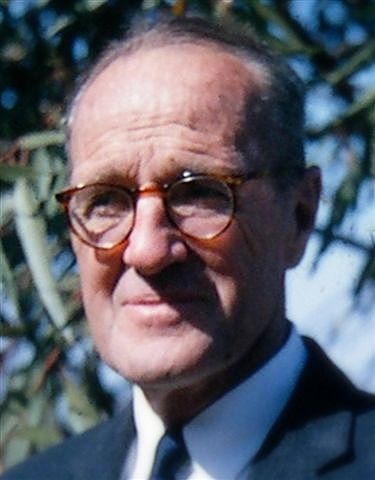
Friday, April 24, 2009

In Memoriam - 12 March 1945 - Lieut Robert Maclagan GORRIE, SX210, 2/14th Field Regiment, 2nd A.I.F.


"KALAI. 12 March 1945: Infantry during the day changed around a little. The hard worn 'C' Coy was withdrawn and 'B' Coy moved through 'D' Coy on Perry's Knoll, and commenced patrol east. The end of the day found them a few hundred yards east of 'D' Coy. They had a hard day without very much opposition, and at no stage were quite sure where they were.
"The weather closed down in the afternoon and visibility was restricted to a few yards. The rain was torrential and persisted from early afternoon until late evening.
"During the morning an Air Strike was carried out by RAAF Beauforts on the suspected mortar position. The target was indicated by smoke shells from our guns. In spite of this strike at 1100h the mortar continued to engage 'D' Coy position. During this mortaring Lt GORRIE was killed by a splinter. He had almost reached Lt SLATER's O.P. as relief when this unfortunate incident occurred. Lt GORRIE was an original member of this unit and his death has been keenly felt by both officers and men."
[Unit War Diary, 2/14th Field Regiment, 8th Division, 2nd A.I.F., Research Section of the Australian War Memorial, Canberra.]

The location was the Waitavolo Plateau, New Britain, on the north side of Wide Bay, and just across the Wulwut River, north of the Kalai Plantation, where the 2/14th guns were emplaced.

Bob GORRIE's body was brought down by Bombardier FREEMAN and a party of men from 'D' Coy of the 19th Infantry Battalion, and buried by a detachment of the 14/32nd Infantry Battalion, between the Mevelo and Wulwut Rivers, at 1630h the same day (Waitavolo - Grid Ref 1:25000, 611519).

His sister, Betty PIGOTT, still in Adelaide, was to receive her third major piece of personal bad news of the war, in a letter written by Bob's widow, Judy GORRIE formerly THOMPSON (Betty's close friend from their days at the Invergowrie Homecrafts Hostel in Hawthorn):
"What can I say - we are both feeling too much at present to think straight... I had been feeling worried about Bob as I've heard nothing from him for 10 days, the last letter being written on 25th February..."
And again, a few days later:
"Rod NICHOL wrote to me and also to his mother, and she came to see me this afternoon. It appears that Rod had been up the front and being relieved, spoke to Bob at his staging camp on the night of the 11th. The following morning, Bob went up and soon after he arrived, was hit by a mortar bomb and killed instantaneously, so thank goodness he didn't suffer. Rod says they got the news by lunchtime, so it was all very quick. He also said that Bob was well, but very quiet, so it looks as though he had some idea of what was ahead of him..."

Bob was aged 32, and was survived by his widow Judy (later Mrs MORLEY), and by their daughter Alison Janet (Jan) GORRIE (later SMITH), whom Bob had never seen.
His remains were re-interred, firstly in Tol War Cemetery (grave No CA13), and finally in the Rabaul War Cemetery, Bitapaka, (Plot E, Row B, Grave 15).


Siblings Bob, Betty and Peter GORRIE, in Adelaide, 1941.

For Betty PIGOTT, the news was hard - she had now lost the three men-folk of her family - her younger brother Pete was shot down and killed over Kema Bay, North Celebes Island, in January 1942 (see his separate blog on this blog-page), just a couple of weeks before their father, Dr Peter GORRIE, was killed at his action-station, the Surgery of the British Merchant Ship "Madura," in Dempu Strait, off the coast of Sumatra.

With Bob, in Rabaul War Cemetery, Bitapaka, also lie the remains of his Regimental Comrades who fell at Waitavolo:
VX53536, Lance Bombardier R.A. BOSTOCK; SX10416, Lance Sergeant D.G. MATTHEWS; QX26019, Gunner R.D. O'CONNOR; NX58632, Lieutenant J.G.A. ROACHE; and VX25782, Gunner D.K. RUTHERFORD.


Detail from 2nd World War Cloister, Australian War Memorial, Canberra.


Detail from the Adelaide War memorial, North Terrace.


Grave in the Bita Paka War Cemetery, near Rabaul:


[Photo by Bob BOSTON.
 Image courtesy of the Findagrave web-site.]

From "The War Dead of the Commonwealth," Compiled and Published by The Commonwealth War Graves Commission, London, 1960, at page 11:


The layout of the Bita Paka War Cemetery, near Rabaul, published at page xii, facing page 2 of the Register:


Bob GORRIE's final resting place is located immediately under the letter "E", an over the word "AUSTRALIAN."


*  *  *  *  *  LEST WE FORGET  *  *  *  *  *


SOME PHOTOGRAPHS OF BOB GORRIE AND SOME FRIENDS, 2/14th FIELD REGIMENT.


"No 4. Tom again. Is it the enemy or a PUB!"


Not annotated.


Not annotated.

______________________________________________


BOB's EARLY LIFE.

Robert Maclagan (Bob) GORRIE was born in Port Elliston, South Australia, 21 January 1913, first born child of Peter GORRIE, M.D., and Janet Howatson YOUNG. His parents, both from Scotland, had been in Australia only a couple of years. He was named for his father's younger brother, who had himself been named for his and Peter's maternal grandfather, Robert MACLAGAN, Station Master of Perth General Station.

Bob was only six months old when his parents moved to Petersburg, and 2 and a half when his mother took him and sister Betty to stay with their aunt in India while their father went to war.

He was five and a half when his family moved to Port Augusta, and began his formal education at the State School there. He was nearly ten when the move to Mount Lofty was made, and it is possible that his parents thoughts had turned to his further education, which was completed at Scotch College, Mitcham.
Bob went to work as a Jackeroo, beginning at Yardea, a McTAGGART property managed by Jim BRODIE, a good friend of the GORRIE family from Peter's days in Port Augusta. Bob was enrolled there as Station Hand in Electoral Rolls from 1933 until 1936, although his sister Jan PAY recalled that he may have gone there as early as 1929, aged 16.

From Yardea, in 1934-35, Bob went to Eremeran Station, a Goldsborough Mort and Company property, lying between Condobolin and Nymagee.
He transferred to another G-M Coy property, Canonbar Station, near Nyngan, in N.S.W., in 1936.
And in late 1937, he went to Thurlagonia Station, at Cunnamula, Qld, owned by the Squathling Investment Company.
It was from here that Bob returned Adelaide to enlist in 1939.


BOB ENLISTS IN THE 2ND A.I.F.

When war broke out, he was at Cunumulla, in Queensland, and immediately returned to Adelaide to enlist. Had the queue at the Recruitment Office been handled from the front, Bob's service number might have been lower. As it was, to his indignation, it was processed from the rear, and Bob was enlisted at Keswick on 20 October 1939 for service in the 2nd A.I.F. as SX 210.

His first posting was as a Driver, with the rank of Gunner, 2/3rd Field Regiment, with their H.Q. in Gramp's Wine Pavilion, Adelaide Showgrounds, Wayville, and initial camp established by 7 November at Woodside.

The Regiment, joined with its W.A. contingent, marched through Adelaide on 11 December and were entrained for Holsworthy Camp, Liverpool. Whilst training for war, the Regiment were called upon to fight bushfires, and to help control riots at Central Station, perhaps associated with a looming national coal strike. Bivouacs were held in the area between Windsor and Penrith (when a flag from the Log Cabin Hotel was souvenired by one of Bob's Regimental colleagues). 
Gunner Bob was promoted Lance Bombardier, 8 April, and Bombardier, 22 April.
On 4 May, the Regiment was marched out, and embarked on H.M.T. X1, otherwise know as the Queen Mary, for service in Europe.


BOB LEAVES THE 2/3RD FIELD REGIMENT.

But Bob had been detached and was attending an A.I.F. Special Field Artillery Course, conducted at the School of Artillery, Holsworthy. He did not sail with his Regiment, nor was he ever re-joined with it overseas.

Instead he was posted to Sydney Showgrounds as an instructor, and there he was part of 9 Troop, 3rd Battery, 1st Field Training Regiment; on 5 July he was promoted Sergeant. On 23 September he was marched out to Victoria, and posted to 2/2nd Field Training Regiment, firstly at Geelong, and then, from 11 November, at Colac.

On 2 November 1940, Bob, on a brief spell of Leave, and probably in-between Regimental postings again, was married in the Presbyterian Church in Castlemaine, to Ilma Beatrice Leviny (Judy) THOMPSON, a great friend of Bob's sister Betty, whom Bob notified by telegram:

"DECIDED LAST NIGHT. MARRIED SUNDOWN TODAY. ARRIVE ADELAIDE TUESDAY. LEAVE WEDNESDAY."


BOB JOINS THE NEW 2/14TH FIELD REGIMENT.

Bob was recruited into the newly created 2/14th Field Regiment, formed as the third Artillery Regiment of the 8th Division, although within three months, with the losses on Ambon, Rabaul and Timor, and the surrender in Singapore, they remained the sole major combat unit of the 8th Division still on the Australian Order of Battle.

The 2/14th was jointly recruited in Victoria (27th Battery) and S.A. (28th Battery); its first commander was Lieutenant Colonel Jan ("God") SEWELL, and his 2-I.C. was Major R.B. ("Wimpy") HONE; Battery Commanders G.H. CRAWFORD and Arthur RYLAH reported for duty at Keswick 17 November, and by 25 November, they had established the Regiment at Woodside Camp. Bob probably joined them there on 28 November.

The Regiment was ordered to concentrate at Puckapunyal, and traveled there in two stages - 186 personnel traveled by road convoy, departing Woodside on 21 February, the remainder going by train.

Bob was promoted to W.O.II (Acting) on 15 January 1941. He was apparently then in the 28th Battery.


BOB GOES TO DARWIN.

On 15 July 1941, the Regiment proceeded by train to Darwin, where they had been posted to replace the 2/13th Field Regiment. Number 2 Special Train left Wayville Siding, and arrived at Alice Springs on the 18th; convoyed overland to Larrimah (22 July); and then by train to Winnellie (23 July).

Originally based at Winnellie, the Regiment constructed new quarters at Knight Cliffs (now Nightcliff), and were in residence by the onset of the wet season. Christmas dinner, comprising turkey, pork, vegetables, and plum pudding, was judged as "excellent."


"Darwin, 1941."

On 12 January 1942, Bob's younger brother Peter was posted missing-in-action, presumed killed, at Kema Bay, North Celebes Islands. Bob and Peter had met up very briefly on one occasion when Peter flew through Darwin Airport. Bob was informed of the death by his Major, Wimpy HONE, who gave him an eye-witness account of Flying Officer Bill WHYTE.

And on 19 February 1942, the war finally arrived in Australia, when the Japanese first dropped bombs on Australian soil.
The 2/14th Regimental War Diary recorded the event as follows:
"0950 - Air Raid Alarms. Enemy planes and our own fighters seen in 'Dog Fight' off Nightcliff. No advice of the Raid from any other sources than our own spotters. RAAF was immediately advised, and from what could be gathered they had no knowledge of the raid.
"1030 - All Clear.
"1205 - Air raid Alarm. Enemy Bombers, 53 in number, at a considerable height. No advice from other sources than our own."


"Darwin, 1941. From his known height of 6 ft 4 in, it would appear that Bob is on the left"

As a result, the Regiment was placed on Battle Stations; moved to Knuckey's Lagoon (18 March); moved further inland to Coomallie Creek (end of April); and back to Darwin Fortress by 25 May. During this time, Major HONE took over command of the Regiment, and Bob was transferred to 27th Battery, C Troop. By 2 June, Bob had been commissioned as Lieutenant. And in August he spent some time in hospital, severally recorded with Cellulitis, and with Dengue Fever.


BOB GOES SOUTH AGAIN.

Bob left Darwin to attend Serial 1 Refresher Course for officers, Field Artillery, Holsworthy, from 7 December 1942 until 16 January 1943. While there, the rest of the Regiment were moved to Sydney, via Adelaide River, Mataranka, Mount Isa, Townsville and Brisbane. They marched into camp at Loftus, 9 and 10 February 1943. After 24 days Regimental Leave, they went into "hardening training" in preparation for active service overseas. This involved bivouacs in the Royal National Park, Wattamolla and Scarborough areas, and a 19-day exercise over a much wider area, and as far afield as Mittagong, Kangaroo Valley and Nowra. On 14 October 1943, in distant Melbourne, Bob's wife Judy was delivered of their only child, Alison Janet (Jan) GORRIE.
On the same day, the Regiment, including Bob, was marched out of Loftus Camp, and travelled to Brisbane and North Queensland, to undertake jungle training prior to embarkation on overseas service. Part of the Regiment remained at Kalinga, near Brisbane, and then moved to Redland Bay to conduct range practice and barge landings, and back to Kalinga, then Yeerongabilly prior to embarkation. The other part of the Regiment went to Cairns, and sailed for Lae on the Bonteko on 12 November.


Bob GORRIE in camp in 1944.


BOB GOES ON OVERSEAS SERVICE.

Bob appears to have been in Brisbane, and that part of the Regiment embarked on the U.S.S. Stephen Girard on 2 January 1944; in Townsville Harbour (5-10 January); Milne Bay (13 January); and Buna (14 January); they proceeded directly to Finschafen, and were assembled at Scarlet Beach.
On 25 January, the Regiment was transferred to Kelanoa; from there, they conducted "clearing" operations of the area up the coast, "mopping up" as the Japanese retreated northwards. They were operating around Kosit, Gabutamon, Malalamia, Yagomi, and Wotan.
On 20 April, 27 Battery was moved through Finschafen to Saidor on the S.S. Tradut; and then onto Madang; the rest of the Regiment went straight to Madang on the S.S. Edward Baker, arrived 7 May. Here they were to remain in camp until January 1945.


"Bob and W.O. II PARR. Taken at river bridge at Alexishafen, October 1944."


"Left to Right. Bob, Harry TRINNICK, Dick CLEMENTS. Taken outside Officer's Mess, Alexishafen, Nov 1944."


BOB GOES TO NEW BRITAIN - HIS LAST SEA VOYAGE.

On 16 January 1945, the Regiment was embarked on the U.S.S. Jubal Early for transfer to Jacquinot Bay, New Britain. Some strong Japanese resistance had been mounted at the north end of Henry Reid Bay, and the 2/14th got their first whiff of real engagement ahead of them, as they pushed northward up the coast, with the 6th Brigade, and units of the 14/32nd Infantry Battalion. They had secured Kiep by 29 January, and Kalai by 17 February.


"No 5. Mid-day rest. Tom in rear." Probably in the Officer's Mess, Kalai Plantation.

And here, at Kalai, where the 2/14th guns were set up, they focussed their attentions on the Waitavolo Plateau, just north of the Wulwut River. At the top, in dug-outs in the hillside, were lodged Japanese mortars, manned by enough soldiers and ammunition to stall the advance of the Australians, and so cover the rear-guard of the retreating Japanese Army.
On 27 February, Generals STURDEE and RAMSAY gave orders for the Waitovolo-Tol area to be taken and secured. By 5 March, the assault force, comprising units of the 19th and the 14/32nd Infantry Battalions, was on the northern edge of Wide Bay, ready to cross the Wulwut River. There followed a week of heavy fighting, immediately east of the Wulwut, and around hills named for fallen Australian Field Officers (Captain KATH, Captain YOUNG and Lieutenant PERRY), with Artillery support of the Regiments 27th and 28th Batteries, joined on 10 March by the 64th Battery.


Gavin LONG, in his volume of the Official War History, "The Final Campaigns," paints the picture:
"... the direction of artillery fire was extremely difficult as the observation officers were working in dense rain forest, the fall of shot was rarely visible, and the guns had often to be registered by sound. On the other hand the narrow tracks had all been registered by the many Japanese mortars in the Waitavolo fortress area. The main role of the guns was now to silence these mortars - a difficult task as soon as it became evident that they were sheltered in caves where artillery fire became dangerous.
"It was difficult for the engineers to maintain communications with the forward infantry. After rain, the Wulwut River became a swift torrent...
"In an effort to silence the mortars which were bringing down a galling fire, the 2/14th Field Regiment sent 460 rounds over, searching an area 400 yards in depth, and eventually silenced the mortars, although only for the day. On 12th March heavy mortars (the Japanese had improvised mortars to fire 150 mm shells) rained 60 bombs on Perry's [Knoll] and Young's [Hill], killing four (footnote; including Lieut R.M. GORRIE of the 2/14th Field Regt) and wounding nine, including Lt FAUL, and temporarily disabling 12 others with bomb blast. It was a day of torrential rain which reduced visibility to a few yards."
______________________________________________

Bob GORRIE was my uncle.

In Memoriam - 12 January 1942 - F/O Peter C. GORRIE, 407168, 2 Squadron, R.A.A.F.


"...I'll start on Saturday - the squadron went out but didn't have any luck so returned again on the Sunday, and made a raid on Menado, and Peter was the only one to score - he got two direct hits on a light cruiser and blew the stern damn near off it; and after all the bombing was over, they formed up to return and were attacked by Jap fighters.
"The other 2 planes in the squadron dived down to sea level, but Peter stayed up and gave fight, and got a Jap plane, and probably a second. They then returned to their base; and when returning on the Monday morning when they ran into half a dozen of the latest Jap fighters, who were lying in wait for them.
"The others dived, but Peter went straight into them, thinking he could drop his load onto the target before they got him (that is his mates' opinion). Anyway, he downed another fighter before they sent him out of control into the sea. It is reckoned by F/O WHYTE who saw it, that the impact of plane and sea would have killed all the crew instantaneously. WHYTE said it was pure guts that sent Peter down; he didn't know what fear meant; a ten-to-one chance of coming out of it. What is left of the squadron seem to think a hell of a lot of young Pete's actions, and speak very highly of him.
"It's a hell of a blow, old thing, but at least we are very lucky to be able to hear so much of what did happen..."

 [Peter's elder brother, Robert Maclagan (Bob) GORRIE, SX210, Sergeant, 2/14th Field Regiment, in camp at Knight Cliffs, Darwin, in a letter to their sister Betty PIGOTT in Adelaide.]

The date was Monday 12 January 1942; the location was Kema Bay, near Menado, on the northern tip of the North Celebes Islands (Sulawesi), where an enemy fleet was landing Japanese troops in large numbers.

There may have been some minor exaggerations in the story ("official" records later suggested there were only 4 or at most 5 Japanese "Zero" fighters), with some padding to soften the blow of the news back home. But Peter would almost certainly have been aware, within an instant of spotting the "Zeros", that their chances of survival were very much less than one-in-ten, and it seems likely that he sealed his own fate absolutely by holding his course, drawing the enemy fighters off, and giving the rest of the flight a better chance of getting away.

But Betty, the recipient of the sad letter, found it difficult to accept the finality of the result, and often said in later life that she spent the next 3 years waiting for her younger brother to walk through the door, perhaps, she thought hopefully, having escaped to some island refuge.

Peter Creighton (Pete) GORRIE was 23 years of age.

His "mates" in the R.A.A.F., at the highest level, and in the absence of any formal written records of the action (Forward Base records were destroyed on evacuation ahead of Japanese advances, & H.Q. records for the period were destroyed in the first enemy bombing raids on Darwin a month later), had to settle for commemorating his valour, and contribution to the war effort, by naming an aerodrome in his honour - No 14 Aircraft Repair Depot (including No 55 Operational base, No 18 Replenishing Center, No 9 Stores Depot, and No 8 Transport and Movements Office), located just off the Stewart Highway and very near the Rail-head at Larrimah, N.T., was named "Gorrie" aerodrome.

Peter was flying a Lockheed Hudson (Model B14S, Mark I) bomber, serial No A16-12. With him on that last flight from their base at Namlea aerodrome, Burus Island, were his crew of three - the 2nd Pilot, Sgt Wesley Leonard MORGAN (No 408112), and 2 Wireless Air-gunners, Sgt John Edward FARRINGTON (No 17633) and Sgt Keith Richard Theodore McCRACKEN (No 406219).

In the same engagement, one other 2 Sqn Hudson from Namlea was lost - A16-46, with Pilot F/L Parker Henry Russell HODGE, P/O Edward David Guildford HOWARD and Sgts Harold Claude SHORE and Jack MAWDESLY, was observed on the water burning, with a long smoke trail. Only one crew-man, P/O HOWARD, survived, and was repatriated at war's end, after imprisonment by the Japanese.
Two other Hudson aircraft making up the flight that day were from 13 Sqn based at Laha, on Ambon Island, and both were also lost:
A16-7 crashed into Rangowenko, and four bodies were recovered from the wreckage & buried by villagers in their cemetery, including Pilot F/L Geoffrey SATTLER, and Sgts John Graham GOODE, Reginald Anthony Desmond HUNTER and Matthew Roscoe HODGSON.
A16-67, which was never located, with its crew posted missing presumed lost - 1st Pilot F/L Arthur R. BARTON, 2nd Pilot F/O Samuel William CLIFFORD, and Sgts Bernard Samuel BATES and John Lake MILLS.
The fifth aircraft returned to base, piloted by Flight Lt Rob CUMING, who filed the mission report as Wing Commander. But, he was to die within a week, so unable to confirm the casualty reports for official purposes.

There is also evidence, despite the lack of official records, that two other 13 Sqn Hudsons flew to Menado that morning - one piloted by P/O DUNNE and the other by Ron CORNFOOT, both of whom, judging by their published reminiscences, survived the action.

As a result of the losses on this mission, A.C.H. Halong, H.Q. for operations in the N.E.I. area, decided to discontinue further long-range attacks on distantly and strongly held targets.

Peter's name is recorded on the Ambon Memorial:
"GORRIE, Flying Off'r Peter Creighton, 407168, Royal Australian Air Force, 12th January 1942, aged 23, son of Dr Peter GORRIE and Janet Howatson GORRIE. Column 8."


Detail from the 2nd World War Cloister, Australian War Memorial, Canberra.


Detail from the Adelaide War Memorial, North Terrace.


*  *  *  *  *  *  LEST WE FORGET  *  *  *  *  *  *


PETER's EARLY LIFE.

Peter Creighton GORRIE was born in Peterborough, 6 June 1918, younger son of Peter GORRIE, M.D., and Janet Howatson YOUNG.


[Peter Gorrie, aged 1 year 4 months.]

He was only 5 months old when his family moved to Port Augusta, & then aged 5 when they moved again, to Mount Lofty.
Educated firstly at Wykeham School, Belair, Peter was awarded the Form B Speeches Prize, 1930.
In 1931 he moved to Scotch College, Mitcham; he passed his Intermediate Certificate in 1934, with a credit in Physics. In the following year he won 1st Prize in the Senior Neat Dive at the Swimming Sports.
His headmaster, N.M.G. GRATTON, wrote this testimonial:
"He is a boy of more than average mental capacity... He has also taken a keen interest in the various outdoor activities of the school; he is a member of the 1st XVIII and 2nd XI. He is a boy of irreproachable character and gentlemanly demeanour; he is unfailingly courteous, conscientious and painstaking, and has developed into a particularly fine type of young man."

But his schooling was probably cut short by an unhappy set of family circumstances - his father had left the family and gone back to Scotland, and his mother may have had some difficulty making ends meet. So he gained employment, and continued night studies.

Peter's 1st job was with Bennett and Fisher, Livestock Salesmen and Wool Brokers, of Currie Street, Adelaide, where he started on 29 August 1935.

After 11 months, he left them, went north to the River country, and joined the clerical staff of Angove's Ltd, Wine Growers and Distillers of Rectified Spirit and Brandy, in Renmark.
Peter passed the Intermediate Examination of the Federal Institute of Accountants, Melbourne, 30 Nov 1938.

Peter "enlisted" in the Upper Murray unit of the Australian Militia Force in December 1938; it became Renmark "A" Company, attached to the 48th Battalion; he was promoted to Corporal on 16 Feb 1939, and to Lance-Sergeant on 23 Mar; on 7 November 1939, he was appointed Provisional Lieutenant, Active Citizen's Military Force, and attached to the 48th Battalion.


[Peter GORRIE  on the running board, nearest the front. The other staff are unidentified.
The photo is identified by John ANGOVE as being the Cole and Woodham packing shed.]

He served with Angove's until 10 February 1940, when he went briefly to Messrs COLE and WOODHAM, also in Renmark - this firm "... was a wholly owned subsidiary of the ANGOVE's winery, and was a dried fruit processing and distribution company as well as an agent for a variety of farm and block machinery and equipment - it also had the responsibility of sourcing grapes for the vintage each year for the winery side of the business" [with many thanks to John ANGOVE, the present Managing Director of the family business, February 2018].

Peter was also a member of Renmark Golf, Tennis and Cricket clubs.

In mid 1940, he sold his possessions, broke off his engagement to Norrie HIGGINS, farewelled his friend Gilbert ROACH, went for a very brief skiing holiday at Mount Hotham, and then joined up, to go to war.


PETER ENLISTS IN THE AIR FORCE.

On 20 July 1940, Peter enlisted in the R.A.A.F. "...for the duration of the war plus an additional 12 months," at 5 Recruit Centre, Adelaide. as A.C.II, No 407168.


[Peter GORRIE, standing in front of his early "wings," an Avro Anson aircraft, probably at Point Cook].

He was posted to 1 Initial Training School, Somers, 21 July; promoted L.A.C., 16 Sep; posted to 1 Elementary Flying Training School, Parafield, 19 September; and to 1 Service Flying School, Point Cook, 18 November 1940.
Peter learned to fly in Tiger Moth, Gipsy Moth and Anson aircraft; he was promoted Corporal, 9 December; and completed the Inter-Squadron Training Course No 4, 9 January 1941.


[Peter GORRIE in the backyard of his sister Betty PIGOTT's house in Adelaide, 1940.]

Peter was commissioned as Pilot Officer, General Duties Branch, Citizen Air Force, R.A.A.F., 11 March 1941 [Commonwealth of Australia Gazette, No 43, 6 March, page 4610], and 6 days later was posted to 2 Squadron, Laverton, on flying duties. These duties involved patrols over a wide area, covering identification of Merchant Shipping, air-cover for military convoys, enemy submarine searches, and flying as far afield as Mount Gambier, Mallacoota, and Tasmanian waters.

The Squadron had been equipped with twin-engined Lockheed Hudson Bombers from June 1940, and it was in these that Peter now saw service. They were of American manufacture, so were delivered without armaments (the U.S. was then still neutral), but were retro-fitted with British "Boulton and Paul" gun turrets (to R.A.F. standards) and Browning machine guns.


The controls of Hudson A16-12. Photo attributed to "Murray LAWSON via Ken HUTCHISON"
 [reproduced in Stewart WILSON's "Anson, Hudson and Sunderland in Australian Service," 
Aerospace Publications, Canberra, 1992, page 90].

Pilots had to treat the Hudson with respect - they were inclined to stall relatively easily (several did, with loss of crews - one crashed in Canberra in August 1940, killing a number of Senior Military Personnel and Government Ministers, including James FAIRBAIRN, the Air Minister, in whose honour the Canberra Air Base is named).


Peter GORRIE, 4th from the left, with 2 Squadron colleagues, beside a Hudson Bomber from "A" Flight, 
at Laverton Airbase, Point Cook, about October 1941. 
The others, from left-to-right, are identified [in Australian War Memorial Print No P 0964/05/05] as 
Robert LAW-SMITH, Jock WEBB, John RYLAND, our Peter GORRIE, Jim HARPER and Bill WHITE.


PETER GOES TO WAR.

By agreements with the Dutch Government, Australia decided to establish forward operating bases in the Netherlands East Indies.

In September 1941, "A" Flight, 2 Squadron, comprising 4 Hudsons, flew to Darwin (under their control, 26 September to 3 October), and then on to various sites "...to make thorough studies of their deployment bases" at Halong, Laha, Namlea and Koepang, conducting searches as they went. They returned to Laverton on 6 October, via Cloncurry, Townsville, Archerfield and Richmond. On this mission, Peter co-piloted Hudson A16-18 with Flight/Lt HEMSWORTH, with A16-6 (Sqn.Ldr Frank HEADLAM), A16-12 (F/Os Robert LAW-SMITH and Kim BONYTHON), and A16-80 (Fl/Lt CUMING and P/O TAYLOR). It was the third aircraft, A16-12, in which Peter flying when he was killed 3 months later.


Two 2 Sqn Hudsons in "camera" formation. The pilot bears a passing resemblance to Peter GORRIE. 
Photo attributed to Neil MacKENZIE [and reproduced in Stewart WILSON's "Anson, Hudson..." 
as cited above, page 112].

The Australian War Cabinet approved the despatch of advance parties to these forward bases in early December 1941. Four days later, two flights from 13 Sqn left Darwin for Laha (Ambon Island), and one flight from 2 Sqn arrived at Koepang (East Timor), from Laverton via Darwin, under the command of Flt-Lt Rob CUMING.

And as they flew north, America was being bombed into the war at Pearl Harbour. On 7 December, the Koepang Hudsons bombed a Japanese pearling "mother" ship, the Nanyo Maru (suspected to have been a disguised radio ship), and damaged it sufficiently for it be beached and abandoned. The Squadron had drawn it's first blood.

Peter probably arrived a little later, as his service file records that he was posted "Overseas on Active Service Department" on 11 December. The Squadron was fully assembled at Penfui Base, 4 miles east of Koepang, by 12 December.

Peter wrote from Penfui to his sister Betty in Adelaide, his location concealed to pass the censor:
"...Everything is still O.K. here and am enjoying life very much - no more close shaves so far, and the little yellow chaps are not too troublesome YET! Although it won't be long now.
Am still keeping pretty fit, and haven't caught any of the local tropical troubles. Only one catch - I burnt a couple of fingers rather badly, and they have been fairly painful for several days, but are clean enough now, and healing O.K.
"Have still no word of Bob, but believe he is still in Darwin. Have written several times so shall probably get some word when this rotten mail arrangement settles down. I believe they are sending our mail overland instead of airmail. So would be grateful for some Aust 3d stamps, if you could oblige."


He was still at Penfui at Christmas, when he wrote again to his sister:
"Hope I am not too late to wish you a happy Xmas - but the mails are a bit uncertain up here so will make it retrospective!
"Things are much the same here, plenty of flying, and I have opened my account in action - got angry and laid a couple of eggs - unable to report the result on paper, but target must have a BEAUTIFUL HEADACHE and how! Am hoping for a bit more of it...
"The weather here is not unbearable as yet, and I have collected a very decent tan from waist up. We strip to shorts and shoes for flying, as the temperature in the cockpit remains at a steady 40-43 degrees (ask Robert what that is in Fahrenheit); anyway its plenty, especially without much draught. We are rationed to a bottle of beer a day, which is better than most active service stations. However I don't know how long the supply will last.
"The hours are fairly long. Today, for instance - up at 3.45am, 5 hours flying before lunch and 'stand-by' near aircraft till 6.00pm, then supper, shower and bed. Still only odd days we get half a day off, and on 2 occasions have managed to get a very enjoyable swim (about the only form of exercise we are able to get), even then you sweat in the water!"

Peter was transferred from Penfui to Namlea Base on Burus Island in early January. This move, of four Hudsons from Koepang, was necessitated by a Japanese raid on Babo Base in Dutch New Guinea, when three 13 Sqn Hudsons were sent over from Laha (Ambon Island), and were replaced by three from Namlea.
From this time, the two Squadrons operated effectively as one.


From Namlea, Peter wrote the last letter that his sister Betty received from him:
"I am at a different spot now (since my last note) and it has proved to be better in many ways. The weather has been very pleasant for this part of the world, and I am pretty fit, apart from having the hell scared out of me at various odd intervals. I often wondered what it would be like to deliberately fly into the fire of about a dozen machine guns - well now I have a pretty fair idea! Not the best for the first quarter of an hour - and it had the effect of leaving me with a very dry mouth and a very firm clutch on the (stick deleted) wheel.
"However, more than that I'm afraid I can't say. It's very hard to write a letter when you can't put any of the local doings in, as apart from that, there is no news. Anyway, I'll keep writing whenever I get the chance and keep you posted as to whether I still have a whole skin or not, & don't take that too seriously as I am a bit fond of the same old hide!!
"You can keep a bottle of Coopers on ice for me if you will, because it is a cheering thought even if I can't get at it! We've been out of beer for some time.
"Incidentally I have one more item I forgot. Xmas was quite an enjoyable event... In the evening we had a very good meal (formal!), some various sorts of wine, and in all a very good time, followed by a sleep in in the morning - so who could ask for more?"

By 2 January 1942, increasing Japanese activity in the region had created pessimistic views about the Australian efforts; A.C.H., Halong, wired the Central War Room that plans had been made to destroy fuel and bombs at Namlea & Laha, and to demolish the Operations Room at Laha.
Japanese Flying Boats bombed both bases on 7 January.

At about this time, another international incident occurred, as recorded in the 2 Squadron Unit Diary:
"Three Hudson of 2 Sqn were (indec word) to attack a destroyer which had been sighted 300 miles N. of Namlea. It was located, attacked, and partially disabled by a flight from Namlea led by Fl/Lt CUMING. One aircraft was damaged by A.A. fire, but reached base safely. The destroyer was later found to be the U.S.S. Perry (sic) and arrived at Amboina with some casualties. No blame for this incident was held against the attacking flight as the destroyer had been sighted and shadowed by a U.S. Catalina, and A.C.H., Halong, which included a Senior American Naval Officer, had decided on the reports made that the destroyer was hostile, & had ordered the attack."

The U.S.S. Peary (DD226) had earlier been attacked, without injury, by the Japanese. One of the crew later noted their appreciation "...that the Australians were better shots than the enemy!"
The Peary was sunk in Darwin Harbour during the first major bombing raid carried out on Australian soil, 19 February 1942, with the loss of 91 hands.

On 10 January, reconnaissance revealed that a large Japanese fleet (8 Cruisers, 18 Destroyers, 6 Transports and 3 Supply Ships) was bearing down on Minahasa, North Celebes Islands. Overnight, in poor weather, this fleet divided and began landing troops at Menado and at Kema Bay. The enemy land assault on the Netherlands East Indies had begun.


On that morning, 11 January, a flight from Namlea bombed the Japanese landing zones. GILLISON recorded the event in his volume of the Official War History:
"When four Hudson from Namlea bombed another large transport later in the day, without success, they were set upon by Japanese float-planes. The Hudsons gunners scored well in this engagement, two enemy aircraft being shot down in flames. A third was seen to go into a spin from 1,000 feet and was counted a 'probable' and a fourth was seen to alight on the sea apparently damaged. Credit for this action went to the crews piloted by Flt/Lt HODGE and F/O GORRIE, both from No 2 Squadron. From this exciting encounter the Hudsons returned, each with minor damage from enemy gunfire, and one temporarily unserviceable. These crews reported having seen fires burning in the vicinity of Menado and Kema."

The flight, with another from Namlea, returned to Kema Bay the next morning, as GILLISON also described:
"At dawn on the 12th January, the Allied attacks on the enemy forces invading Celebes was resumed. On their way to Menado, five Hudsons from Namlea were intercepted by three enemy float-planes and five Zeros - the first of these Japanese fighters to be reported in the area. The Zero pilots immediately turned the tables on the Hudson crews. In unequal combat, the details of which were never recorded, the aircraft piloted by HODGE and GORRIE were both shot down from between 6,000 and 10,000 feet. Two other Hudsons, piloted by Flt/Lt SATTLER and Flt/Lt BARTON, failed to return and their crews were listed as 'presumed lost.' The only aircraft to return was that piloted by Flt/Lt CUMING, who reported having seen the Hudsons flown by HODGE and GORRIE shot down."


THE AMBON MEMORIAL.


[Images courtesy of the aircrewremembered.com web-site.
Peter GORRIE's name appears in Column 3, about half-way down.]


______________________________________________________________________

Peter GORRIE was my uncle.

Sunday, July 20, 2008

The Hon. Member for Calare: Henry Robert Maguire PIGOTT, M.H.R.


[Harry PIGOTT's "Official" portrait as M.H.R, as published in
 the Commonwealth Parliamentary Handbook.]

Harry PIGOTT made a good impression on his entry into National politics:
"The Censure debate was resumed by Mr PIGOTT, the new representative for Calare. Mr PIGOTT dealt temperately with the various political issues. He is a clear speaker, with a complete knowledge of country interests, has a pleasant manner AND clearness of utterance that are both assets for a newcomer."
[The West Macquarie, 30 September 1913, citing the Sydney Daily Telegraph.]

His parliamentary career, which began with the General Election of 31 May 1913 (he was defeated in an earlier attempt on the same seat in April 1910), was not a stellar one, and is detailed below. He was re-elected in September 1914 and May 1917. His defeat in December 1919 led to this cable from W.A. WATT, the Treasurer, and for a time Acting Prime Minister:
"Deeply regret your defeat. I feel sure you will take it like a sportsman. Trust that the New Year will be kinder to you and that the future will bring you happiness AND prosperity."

Politics intruded upon the second of three stages in Harry's adult life - the first was in banking, from his leaving school in London in 1883, until the closure of his branch of the Australian Joint Stock Bank in Blayney, N.S.W., in 1899; the second was in business in Blayney as a Stock and Station Agent and Auctioneer; and the third was as a Grazier at his property "Cadara" near Tottenham, in Central Western N.S.W.


EARLY LIFE IN CEYLON AND SCHOOL IN LONDON.

Harry was born Henry Robert Maguire PIGOTT, in the Colombo suburb of Matakuliyah, Ceylon, on 2 October 1866 - this event was the subject of a Birth Notice, published in the 'Homeward Mail from India, China and the East,' dated 12 November 1866:
"PIGOTT - Oct. 2, at Matakooly, wife of the Rev H.R. PIGOTT, son."
His parents were Baptist Missionaries, the Rev Henry Robert PIGOTT (see his separate posting on this blog-site), and his spouse Ellen GILES. 
Harry was raised in Matakuliyah, with his elder siblings Annie and Frank, and where two younger siblings, Frederick and Norah, were also born; the family moved to another Colombo suburb, Maradana, when Harry was about 4 years of age, living at the principal Baptist Mission House, and where his three younger sisters Effie, Mary and Winfred were born.
With his family, he visited his dying grandfather, Rev John Eustace GILES (see his separate posting), in Clapham, London, in 1875, when he and his elder brother Frank were placed in boarding school, at the School for the Sons of Missionaries, in Blackheath Village, County Kent, run by an Independent (or Congregationalist) Minister, Rev Edward WAITE, M.A. (this would much later became known as Eltham College). Harry was enumerated there in the 1881 Census, aged 14, but incorrectly attributed with the birthplace of Ratnapura, which was instead where his parents were then living.

Harry left school in December 1882, and was employed from 2 January 1883 as a junior bank clerk "... in Mr BERNARD's office with a Mr MOYSEY in a bank near Liverpool Street Station" in London, later identified as the Bank of Australasia. Harry resided, with his brother Frank, at the residence of their mother's widowed step-mother, Mrs Ellen GILES, at 12 Freke Road, Lavender Hill. When Mrs GILES emigrated to Sydney in April 1883, Frank and Harry removed to lodgings at 46 St John's Hill Grove, Wandsworth, where their landlady was a Mrs THOMAS. Harry wrote to his parents on 15 August 1883, saying that he had spoken to the "... Australasian bank people" - presumably his employers.


HARRY EMIGRATES TO NEW SOUTH WALES.

In 1884, armed with a letter of introduction from Sir Morton PETO (1809-1889), a Baptist civil engineering contractor (who had also been Treasurer of the Baptist Missionary Society), he emigrated to N.S.W., departing London on the R.M.S. Carthage on 8 May, staying a month with his parents in Colombo, and completing his journey with a voyage on the R.M.S. Sutlej, arriving in Sydney on 10 July 1884. His father wrote to his mother, probably then up in the cooler climate of Nuwera Eliyah for the sake of her health:
"Harry left by the Sutlej this afternoon about 5.30. I saw the purser and introduced Harry and said he was a gentleman even though he was travelling second class, and told him to make sure he was alright and in a cabin with respectable people... So departed the Banker, in good spirits, waving a hanky all the way."

PETO's letter of recommendation was to the Australian Joint Stock Bank, a fierce competitor of the Bank of N.S.W. Harry served in offices in Burwood (a Sydney suburb, where the recently arrived Mrs Ellen GILES resided), then in Grafton, Cooma, Milton, Wingham, and finally as Manager in the Blayney branch, from January 1893.
His start in N.S.W. must have gone well. On 3 March 1885, his elder brother Frank, still in London at the Crystal Palace Engineering School, wrote to their parents:
"I knew that Harry would get on all right in Australia. He is very sharp in many ways (takes after his brother) and is bound, if continued with good health, to make a 'Jumbo' at banking. 'Jumbo' here means a big pot. Fancy a rise from £20 to £40 a year. It seems a fine way of getting on."

Harry's entry to Grafton was marked by tragedy - his ship, the Paddle Steamer City of Grafton, was the first vessel to encounter the S.S. Helen Nicoll, which had earlier in the night collided with the S.S. Keilawarra, which sank with the loss of 46 souls, mostly women and children. Harry's ship brought first word of the tragedy ashore, at the Yamba telegraph office, on 9 December 1886.
While in Grafton, his skills as a swimmer were put into good use during one of the regular floodings of the Clarence River.


[Harry aged 21. Photograph taken in 1887 by Falk Instantaneous Portraits, 496 George Street, Sydney.]

Harry then went south, where he spent some time at the branch at Summer Hill, in Sydney, as this item illustrates, even as he was being sent further south again:
"Mr H.R.M. PIGOTT, acting accountant of the Summer Hill branch of the Australian Joint Stock Bank, has been promoted to the position of accountant at the Cooma branch."
[Evening News (Sydney), Tuesday 23 August 1887.]

The N.S.W. Electoral Rolls first record Harry in the Electoral Division of Monaro, by right of residence in Cooma, in for the rolls of 1888-89, and 1889-90.
The Cooma Express noted, in it's issue of Saturday 16 March 1889:
"Mr PIGOTT, formerly accountant at the Cooma A.J.S. Bank, is acting manager during Mr SEELEY's indisposition."

Harry's next posting was to the branch at Milton, near Ulladulla, on the N.S.W. South Coast. He was here from July 1889 until April 1892, and it was here that his parents arrived to stay from Colombo in January 1890. Harry's appointment as Manager, at a salary of £200 a year, was approved at a meeting of the full Board of the Bank on 16 July 1889; his last Manager's letter was sent to the Board on 28 March 1892. While there, he would walk 5 miles to Yatte Yatte, just to play tennis. He was enrolled for the Electoral District of Shoalhaven, 1890-91 and 1891-92, by right of residence in Milton.

This glowing tribute was made to Harry on his farewell from Milton:
"The following address has been forwarded to Mr H.R.M. PIGOTT... by his friends in the district, as a token of esteem and regard: -
"To Mr H.R.M. PIGOTT, manager of the Australian Joint Stock Bank, Milton.
"Dear Sir - On the occasion of your leaving for the metropolis, a few of the residents of Milton who have enjoyed your society and friendship during the past 3 years desire to assure you of their sincere regret at your departure.
"Your kind and gentlemanly bearing, your unfailing frankness and courtesy, your constancy in friendship, your strict integrity, and above all your genuine christian character, have won golden opinions and will keep your name fragrant in the memories of those who now address you.
"In partaking, they ask you to accept the accompanying Gold Albert as a slight expression of their respect, esteem and affection, with the earnest hope that you may live long to wear it, and that wherever you may be, your character and worth may be justly and sincerely appreciated, as they have been by them: -
"John RAINSFORD, C.P.S.; (Rev) John Marshall SANDS; G.C. PERCIVAL; John KENDALL, J.P.; William BRYCE; W.A. SHEAFFE; B.A. HEFFERNAN; Walter KENDALL, J.P.; William J. FOSTER; H.P.L. KENDALL; Thomas PATTERSON; W. MILLARD, J.P."
[Ulladulla and Milton Times, Saturday 28 May 1892.]

Harry spent a short time at the branch in Wingham, near Taree, perhaps also on a temporary or "relief" basis. I have been unable to confirm the dates, but it would appear most likely that it was between his departure from Milton in April 1892 and his appointment to Blayney in January 1893.
It was probably during this period that Harry kept bees, and delivered a Lecture on Bees and Beekeeping "... in the School of Art last Tuesday evening." The broadsheet newspaper clipping of the Lecture, which was, unfortunately, undated, but noted the following:
"... at the conclusion of the lecture, Mr NAYLOR moved a vote of thanks to Mr PIGOTT, and to Miss PIGOTT, who had prepared the diagrams... Mr PIGOTT says that in preparing it he was greatly assisted by Dr ALLAN, and also obtained a lot of very valuable information from the book called 'Root's A.B.C. of Bee Culture.' But the bulk of it was obtained from his own observation."
Harry was quoted as saying:
"My brother and myself who go in for none but Italians (bees), are determined to introduce one or two new imported queens into our colonies every year, in order to keep up the strain. We are trying also top convert our neighbours to the Italian."
The mention of his brother, probably his younger brother John, and his sister, clearly suggests that he was probably keeping bees at his father's orchard Kellyville, rather than in Wingham.


HARRY SETTLES IN BLAYNEY.

Harry was appointed Manager of the Blayney branch, at a salary of £225 a year, by letter dated 17 January 1893. The letter was addressed to him in Sydney, so he may have spent some time in Head Office after his brief posting in Wingham. He managed the branch until it was closed in 1899, and specifically, from the time of his appointment, at the culmination of a banking crisis in N.S.W. brought about by the high levels of credit being extended on property deeds, corresponding with a major recession in rural Australia. By 17 May 1893, 12 major banks had failed, including the A.J.S. Bank, which closed it's doors on 21 April. Most of them restructured, and re-opened, the A.J.S. on 19 June 1893. But it, and other banks, immediately began to consolidate and contract their scope of operations; within three years, nearly half of their 170 branches in N.S.W. had been closed down.

Harry lived in the bank premises, on the corner of Adelaide and Water Streets, as recorded in the Australian Town and Country Journal [Saturday 18 March 1893], in their report of an incident at the bank on the evening of 10 March:
"... The Manager (Mr PIGOTT), who sleeps on the premises, was out during the evening, and returned about 11 o'clock. On looking over the premises before going to bed, he was confronted by a man behind the bank counter, who threatened to blow his brains out if he attempted to move. The Manager, thinking the burglar had taken possession of the Accountant's revolver, which is kept in a drawer close to where the man stood, complied with his request. The man then made his escape through the Manager's room and out the back door. About 6 shillings in cash was taken. An examination of the premises showed that an entrance had been made by the back window, which had been prised open by a chisel or some other implement."
The culprit was identified independently by Blayney Police (Senior-sergeant ROCHE and Constable LENEHAN) as being Bertie GLASSON wearing a false beard, whom they met in the street near the bank on the night in question; and although never reported up the chain of Police command, the "incident" was characterised by them in a subsequent explanation to the A.J.S. Bank Head Office in Sydney as a "practical joke."
But the joke back-fired in a spectacular and shocking manner in the following September, when GLASSON, while attempting to rob the City Bank in Carcoar, killed the manager and his married daughter with an axe; he was later arrested in Cowra, put upon his trial for murder, convicted, and hanged in Bathurst Gaol on 29 November 1893, aged 26.
In the light of GLASSON's arrest and trial, further reference was made in the Press concerning the earlier incident at the A.J.S. Bank in Blayney, with the Bathurst Free Press [Saturday 7 October 1893], citing a report in the Blayney Advocate, as follows:
"We have also interviewed Mr PIGOTT in reference to this matter, and his statement is to the effect that on the first night of the Blayney Show (held in March last) he, with some others, was spending the evening up at Mr GLASSON's, and upon returning to the bank at about 11 o'clock found one of the windows had been tampered with and left open, but in consequence of a big nail it could not be opened sufficiently to admit a man without breaking the framework altogether..."
It is interesting that the two versions differ - but it is unclear whether Harry altered his version of events, or there was some editorial excision of GLASSON's involvement (perhaps seeking to avoid tainting the then judicial proceedings under way against GLASSON for the Carcoar murders?).
The article went on to argue that since GLASSON had been identified by Police in connection with the earlier bank burglary, then Police action against GLASSON at the time, even in the form of a formal caution, may have prevented the Carcoar atrocity.

Harry either still played football, or had a hand in the "management" of those in Blayney who did. The Bathurst Free Press [Tuesday 11 September 1894] reported, from their correspondent in Trunkey, about a match between the Trunkyites and the Blayney Rovers scheduled to have been played at Newbridge on the previous Saturday, it being the final game of the season, and that only six members of the Blayney team had shown up, along with the umpire (Mr CLEMENTS of Blayney):
"After waiting for a long time for the remainder of the Rovers, the Trunkey captain received the following telegram from Mr PIGOTT of Blayney - 'Very sorry; last moment many members declined to go; accept sincerest apologies'..."
The Newbridge locals, for whom this was their first hosting of such a match, were not impressed that the Blayneyites had "... been afraid of being defeated by the little town of Trunkey."

On Tuesday 18 April 1899, the Board meeting of the A.J.S. Bank received a Report by the Chief Inspector, respecting the Blayney Branch Inspection:
"The Manager to be severely reprimanded, and cautioned as to his (further - struck through) future conduct."

I can find no explanation as to why Harry was in trouble, and can only assume that he may perhaps have overstepped the mark as regards conditions for loan approvals. Branch Inspections were usually only carried out as a prelude to closure, so Harry should have been alerted to possible future insecurity of his position with the bank in Blayney. He married in 1898, but rules prohibiting staff on under £200 a year from marrying, on pain of dismissal, clearly no longer applied to him; and another bank rule prohibiting comment on political matters, particularly during election campaigns, may have rankled with Harry, especially during his father's tilt at Sherbrooke in the 1894 General Election, but that was well before 1899. Perhaps, instead, he had already begun to test the waters of his new venture in business in Blayney while the bank was still operating, which may have put him offside with his superiors; or more likely, the negative report spurred him into action to provide for his post-banking career.


HARRY OPENS HIS OWN BUSINESS.

Harry opened up in business as a Stock and Station Agent in Blayney, perhaps as early as the middle of 1898, and if so, clearly while he was still managing the Bank branch there; he later advertised the venture in the Blayney Advocate of 18 August 1900, as follows:
"H.R.M. PIGOTT, Stock, Station Agent and Auctioneer. Sheep, cattle, horse and general sales held on 1st and 3rd Saturdays every month at 2.30 p.m. Good lines of sheep for private sale always on hand. Cheap properties for sale in Orange, Carcoar, Grenfell, Cowra, Molong and Blayney districts. Correspondence promptly attended to. New Offices at sale yards, Old Mill premises."

By 8 September 1898, Harry was able to advertise yet another move to a new office in Adelaide Street, no doubt in the south end of the Club House Hotel building, which he occupied for another 30 years. It contained two rooms, an outer and inner office, although neither were very private, so Harry was obliged to hold his more confidential meetings in the back seat of his motor car in the street - but that was later on - in the early days, before the war, he drove a phaeton, drawn by a horse named "Rocket," which was also ridden to local appointments by his office boy.
The glass of the external window was etched with his "shingle":
"H.R.M.PIGOTT - Stock Station Financial Agent - Sworn Valuator under R.P.A. - Agent for A.M.P."

Harry appears to have run the business as sole proprietor. He placed it the hands of a manager, I.J. CLEMENTS, when he was elected to Parliament in 1914. Prior to that, in 1912, he had engaged a junior office boy, named Creel PRICE, who got "the shock of his life" when Harry offered him the Manager's position after CLEMENTS left for Sydney in 1918. Creel was to work with Harry until he retired to 'Cadara' in 1932; he then purchased the business, and kept it on until 1949, when he sold to Harry's son-in-law, Paul CUTTS [see Creel's memoirs, "On the Wallaby," published in 1987].
Creel recalled his engagement by Harry in a conversation with Garry REYNOLDS:
"PIGOTT did so well that he approached the local headmaster with the question, 'Who is the smartest boy you have here?' On being told 'Young Creel PRICE' he offered the lad a job, which was taken up..." [See his "King's Colonials: the Story of Blayney and District."]


[Creel PRICE standing in the office doorway, part of the Club House Hotel, Adelaide Street, Blayney.]

Among a number of his registered real estate purchases in the area, one important one was dated 10 May 1900, for "Iona", a brick residence in Clarke St, Blayney, on over 13 acres of land at the end of Albion Lane. This became Harry's principal residence after his marriage, enabling him to remove from temporary arrangements with his parents-in-law at the Manse in Church Street, where his first child was born in 1899. "Iona" was disposed of by Harry's executors in 1950.


["Iona" in Clarke St, Blayney, November 2012, at the northern end of Albion Lane (now Street), which runs north off the Carcoar Road just west of the intersection with the top end of Adelaide Street.]

Another was the transfer of the Leasehold of 'Cadara' on 9 April 1929, by an irregular transfer annotated on the Conditional Lease Tenure Cards in the Deeds Office with the letter "R" - probably indicating that the Mortgagors, unhappy with performance of the Mortgagees, made a Request for transfer of the Conditional Lease to Harry PIGOTT, who was probably already a "sleeping partner" with the Leaseholders, George PILE and Robert CLEMENTS, both Blayney men.
Harry was later said to have been in possession of the 13,000 acre Cadara property since 1910, and dissolved his partnership with George PILE on 19 June 1920 [N.S.W. Government Gazette, 2 July], to carry on the business as Grazier on his own.
Sands Directories record, for the Condobolin Pastures Protection District, the following entries:
1913 - CLEMENTS and PILE; 1914, 1915 - PILE and CLEMENTS, "Candys" and "Condys"; 1916, 1917, 1919, 1920 and 1921 - PILE and PIGOTT, "Candora," "Candara," and "Caudara"; 1922, 1923, 1924 - PIGOTT, H., "Cadara"; 1926, 1927, 1928, 1929, 1930 - PIGOTT, H.R.M., "Cadara"; and 1931 and 1933 - PIGOTT, J.A., "Cadara".
Post Town was Lansdale (1913-15); Trangie (1916-17); Tottenham (1919-21); Blayney (1922-23); and Tottenham (1926-33). Acreage was 10,240 (1913-17); 12,800 (1919-20); 10,240 (1921); 12,020 (1922); 12,084 (1923); 15,260 (1924); and 12,840 (1926-33). Sheep numbers on the station varied from 1,506 in 1915 to 11,709 in 1920, with most years averaging around the 4-5,000 mark.
Harry sold Cadara shortly before November 1945 [Lyndhurst Shire Chronicle, 29 November], when he retired to live in Manly.

But Harry's time at 'Cadara' did not come until after his career in National politics.
And he got into a spot of bother with rabbits - which resulted in him being declined the benefit of half rates for rabbit proofing, which was found to be defective on his western boundary during an inspection on 26 October 1932. Harry, with his son (Jim), his manager, had gone next day to repair the fence, as instructed by the inspector, one Mr TOUGH. In his remonstrations with the Board over this matter, Harry acknowledged that there were large clusters of warrens just outside his western boundary, and that he had had men cutting and mattocking the burrows, and burning the cover; and protested that his was one of the most rabbit-proofed properties in the district. Jim left "Cadara" in the following year (he purchased "Back Woodlands" near Narromine in September 1933), having evidently come to the conclusion that he and his father could not see eye-to-eye on farming matters - perhaps the rabbit proof fencing was the last straw.


HARRY MARRIES A DAUGHTER OF THE MANSE.

Henry Robert Maguire PIGOTT, Bank Manager, aged 31, was married in the Blayney Manse, on 23 March 1898, by his soon-to-be father-in-law, Rev James ADAM (Presbyterian Minister of Blayney), assisted by his father Rev Henry Robert PIGOTT (Anglican Curate of Castle Hill), to Margaret Paton (Maggie) ADAM, aged 24, Rev ADAM's only surviving daughter.


It was reported that the wedding was made into a private affair, as the church would have been unable to accommodate the vast numbers who would have attended any public function involving the popular Minister's family.
Maggie ADAM was born in the Carcoar Manse on 26 August 1874; she believed that she was named for her paternal grandmother; she was 3 when her family moved to Penrith, and 6 when they moved to Sydney; she attended Argyll School, Surry Hills, 1883-1884; aged 9 when the family moved back to Carcoar, and 16 when they moved to Blayney; by the time her father retired, she was 19, and playing the organ in St Paul's Church, Blayney.
The newlyweds left Blayney on Wednesday evening, 23 March, by Mail Train, for Sydney, "... from whence they intend going to Adelaide by Steamer to spend their honeymoon. They will be away for about a month" [Blayney Advocate and Carcoar Herald, Saturday 26 March].
They were welcomed back on the evening of Thursday 20 April, at a social gathering in the Presbyterian Church.


HARRY GOES INTO NATIONAL POLITICS

A State Election was held in N.S.W. in 1908. Harry was then Secretary of the Blayney Electoral Liberal League, and wrote several pamphlets for them in reply to the Labor candidate Mr BEEBY, and particularly in reference to Labor's Land Policy which called for Nationalisation. In the following year, Harry first represented Blayney at Farmers and Settlers Conferences; and in 1910, Harry first stood as a Liberal candidate for Calare in the Federal Parliament.
The Division of Calare was created in 1906 after a re-distribution, and was won by Labor's Thomas BROWN; in 1909 it comprised polling places at Barmedman, Bimbi, Bogan Gate, Canowindra, Cowra, Cudal, Eugowra, Forbes, Grenfell, Molong, Obley, Parkes, Peak Hill, Temora, Trundle, Waroo and West Wellington.

Harry was expected to do reasonably well on his first attempt. The West Macquarie wrote, eleven days before polling, that his chances were regarded:
"... by those who should know, to be very bright, and political campaigners are tipping him to win by several hundred votes. If he is beaten, it will not be for the want of work, as our Blayneyite has been a trier from the word go."
But the voters thought otherwise, and Harry lost to BROWN by nearly 1500 votes - his 9,147 votes to BROWN's 10,561.
In the aftermath of his failure, moves were made to draft Harry as a candidate for the State seat of Blayney, but Harry would have none of it, as he wrote to the Telegraph:
"Although I have received numerous requests to come forward, it is not my intention to do so, for the reason that I am determined to hold myself in readiness to again submit my name to the Liberals in the Federal electorate of Calare, three years hence."

By the time Harry made his second attempt on Calare, several alterations had been made to the electoral boundaries - Barmedman, Bimbi, Grenfell, Peak Hill and Temorah polling places had been removed from the Division, and Orange, Stuart Town and Wellington had been added. And this time, in general elections held on 31 May 1913, Harry was successful - improving his own vote by 2,700 by polling 11,848 votes to BROWN's 10,911. Joseph COOK formed a new Liberal Government, although Labor still controlled the Senate, a situation which culminated in the Double Dissolution election of 1914.

Harry delivered his his maiden speech to Parliament, then sitting in Melbourne, on 21 August 1913, as part of the Address-in-Reply to the Governor-General's speech, and speaking for 1 hour and 45 minutes. He began:
"I need not say that I am proud to be privileged to take part in the public debates of this National Assembly, not because of a personal achievement in securing a position in this House, but because my return enables me to assist in restoring responsible government in this great Commonwealth of ours.
"I desire to take advantage of the opportunity to congratulate you, Mr Speaker, upon your elevation to the high office you now fill, and upon the action you have taken in restoring the mace to the table of this House."

Harry went on to refute a claim that the Liberals held their conferences behind closed doors:
"I have personally attended five Liberal Conferences since these conferences were initiated, and I am in a position to give the statement of the ex-Attorney-General a flat contradiction...
"I can only say that I belong to the Liberal Association of N.S.W., and happen to be a member of the council, and I have never seen the doors closed against anyone at a meeting of the party."

Harry also had something to say about the recent coming together of the anti-Labor forces:
"We have been called a fusionist party because Free Traders and Protectionists on this side have agreed to drop their fiscal differences to further the principles of Liberalism. On this ground, our friends opposite are equally Fusionists... The ex-Attorney-General is one of the strongest Free Traders N.S.W. has ever had, whilst the ex-Prime Minister, Mr Andrew FISHER, is a strong Protectionist and the Arch-priest of Protection in Australia."
Harry supported the White Australia Policy, in terms that would be probably today attract charges of racial vilification! And under that banner, he strongly argued for more immigration.
He also argued for the re-introduction of Postal Voting, noting that Labor repealed it because greater advantage accrued to the Liberals from its use; and he vigorously advocated the principle of uneven electorates, citing the advantages of civilisation enjoyed by those in city electorates, and their relative size:
"...a candidate for Parliament could, from an elevated position, make himself heard by the whole constituency with the aid of a megaphone. Contrast Surry Hills with a district like Cobar, in which it would take 3 years to visit every elector, even travelling by motor-car. Those living in the interior are doing the work of the country; they are its brawn, muscle and sinew."
No argument on the last point from the electors of Calare - except those on the Labor side!
He attacked Labor for irregularities in the appointment of a Union official to a senior government post in the Northern Territory; praised the new government for taking rural workers out of the Arbitration Act; and criticised the former government's Australian Notes Act of 1910, and its effect on the money market:
"I have lived in country districts many years. I have been on the land; have engaged in business pursuits; have been a bank manager for some considerable period, and latterly have carried on business as a stock and station agent. I have to deal with people who buy and sell sheep, and engage in various investments, and I say, without hesitation, that during the whole of my 28 years experience of life in country districts, I have never known the money market to be so stringent as it has been the last 3 years."
He went on to elaborate his point with discussion of gold reserves, and even drew comparison with monetary policy in France just after the Revolution! He gave the Commonwealth Bank a serve, accusing it of being badly governed (by one appointed Governor, rather than a Board), arguing that its policy of cheap loans did not get to needy small land-holders. He also attacked the Graduated Land tax, pointing out that it had led to highly variable valuations of country properties; and he concluded with an attack on the Absentee Land tax, on the grounds that the small net gain (of £20,000) was offset by the presence of "... the British Fleet riding supreme at sea, serving to protect our interests in every corner of the globe," and that it was driving capital out of the country.

Some things don't change!


[A coach outing of Parliamentarians, with Harry PIGOTT on the big coach, immediately above the front wheel, 
just in front of the lady wearing the dark, wide-brimmed hat. The photo is undated.
 The name "WEBSTER ROMETCH" appears on the side of the larger coach, indicating that the photo was
probably taken in Tasmania - WEBSTER, ROMETCH and DUNCAN were a firm 
which ran a coach service in Hobart and surrounding areas.
In May 1917, WEBSTER, ROMETCH, Ltd, advertised the sale of their horses, brakes and harness, having decided 
to convert their tourist fleet to motor transport, which suggests this photo predates that event.]

Harry was re-elected to represent Calare for a second term in General Elections held on 5 September 1914, increasing his primary vote and his majority over his Labor opponent, this time William JOHNSON. But the Government he supported was defeated, and Andrew FISHER formed a new Labor Government with a comfortable majority.

FISHER wrote to Harry from Melbourne on 23 September, 18 days after the Poll:
"Many thanks for your kind letter of the 14th September. I am glad to have your assurance of loyal co-operation in these times of uncertainty. With best wishes."
The first World War had broken out in Europe.

Harry was appointed to a delegation which visited Norfolk Island, in connection with a Bill that had been before the Parliament in 1913 for taking over the former Crown Colony, previously under the administration of the New South Wales Government.
A party of ten Members, including three Senators, sailed from Sydney on the Steamer Levuka on 24 December 1914, and arrived at Norfolk Island on Sun 27 December, disembarking passengers between 4.30 and 6.00 p.m. It is possible that he was accompanied by one of his sons, as the S.M.H. recorded the departure of the Levuka from the Lime Street wharf of the A.U.S.N. Coy, the passenger list including both Mr Henry PIGOTT and Mr PIGOTT Junior, probably his eldest son Robbie, the aged 15.


[A Parliamentary adventure - a delegation being landed, probably on Norfolk Island, off the steamer "Levuka."]


[A picnic - probably while on Norfolk Island, if the pines in the background are any indication.
Perhaps the occasion of a cricket match at the Melanesian Mission there.
The young man standing between the two groups bears a passing resemblance to Harry's
eldest son, Robbie PIGOTT, then aged 15 and-a-half, and who did travel with his father.]

The delegation left in the evening of Sunday 17 January 1915, on the Steamer Makambo, via an 8 hour stint on Lord Howe Island, and disembarked in Sydney on Thursday 21 January, during a severe dust-storm.
Harry was reported [S.M.H., Friday 22 January] as stating that:
"They gave us a rattling good time down there - dancing, tennis, all sorts of things. We had a cricket match with the Melanesian Mission, and got licked. Bishop WOOD was playing for them. I can tell you he's a good batsman."

Later that year, on 27 October 1915, FISHER was succeeded as Labor Leader by William Morris HUGHES.
Another year further on, with the defeat of the first Referendum on Conscription, HUGHES was removed from A.L.P. Leadership by the Labor Caucus, and on 14 November 1916 formed a new Ministry from among his supporters in the National Labor Party.
He reached an agreement with the Liberal Party on terms for a merger, and a new coalition Ministry was sworn in on 17 February 1917.

Under these much changed circumstances, Harry was again returned as M.H.R. for Calare in Elections held on 5 May 1917, eventually maintaining his majority over yet another Labor candidate, Thomas LAVELLE.
Calare's boundaries had altered but slightly, with the removal of the Polling Place at Obley.

But the early count wasn't good; Harry received the following telegrams:
Joseph COOK, in Sydney:
"Glad to see your nose in front all good luck. Waiting anxiously further news."
W.M. HUGHES, in Melbourne:
"Sincerely hope later returns will ensure your success."
W.A. WATT, in Melbourne:
"Watching your count with deep interest. Sincerely hope that remaining figures will work out in your favour."

The Nationalists won in a landslide. HUGHES put the Conscription question to a second Referendum, and in December 1917, which was again defeated. HUGHES resigned his commission, but as only he could command a majority in Parliament, he formed a new Ministry which was re-sworn on 10 January 1918.

At the time, Harry was implicated in an "Intrigue" between the Official Labor Party and a "cave" within the Nationalists led by Mr TUDOR. The Western Advocate of 24 January 1918 printed the following report:
"Mr PIGOTT held that the HUGHES Government should have resigned and thereby have fulfilled its pledge, and that a ministry should have been formed from other members, but he never at any time contemplated giving the Official Labor Party any chance to secure office, either by discreditable connivance of Nationalists with Tudorites or by any process which would have ended up with an appeal to the country.
"Although Mr PIGOTT's point of view was that the Government should have fulfilled its pledges by resigning and that a Government should have been formed irrespective of the HUGHES Ministry, he was never consulted further by the 'cave.'
"But to his surprise on the last afternoon of the debate he was approached by a prominent member of the 'cave' who said they had been considering his contention that the Government should have resigned, and had drafted an amendment, which they would ask him to move. As they had already spoken, none of them could move it, so they would ask him. Mr PIGOTT expressed his surprise at being asked to move such an amendment or any amendment half-an-hour before the time fixed for the conclusion of the debate, and declined to do anything until he saw the Government Whip. He was approached by another member of the 'cave' to the same effect and gave the same answer. Failing to persuade Mr PIGOTT, the 'cave' sought Mr Austin CHAPMAN, and it was understood that he would move the amendment.
"Mr PIGOTT then informed Mr Massey GREENE, the Government Whip, of what had happened, and that information was the first intimation the Government had of the amendment. It was to have been sprung on them at a moment's notice and to have taken them by surprise.
"Mr PIGOTT refused to be party to such a method of unseating a Government formed from his own party.
"The statements of the metropolitan papers certainly are assumptions that the 'cave' was in collusion with the Official Labor Party, and there was a certain suggestion that Mr PIGOTT had been in consultation with that party, but Mr PIGOTT never approached them, nor did they approach him, and he never knew of any consultation with the Tudorites, nor of the amendment, nor of the proposal to move it, till the prominent Nationalist informed him they (the 'cave') had been considering his point of view and had drafted an amendment which they would ask him to move.
"Mr PIGOTT, no doubt, saw a certain amount of treachery in the matter and refused to be party to a mean intrigue. No doubt too, he saw what must follow the defeat of the Government, not merely an election, but the probable succession to office of a party whose loyalty is a negligible quantity, or at best lacks emphasis."

The Sydney Morning Herald had implied Harry had joined the intrigue, and Harry, it appears, may have been forced to undertake a little bit of "damage control."

Harry's absence from the Chamber through illness was noticed by the Speaker (Sir W. Elliot JOHNSON), who wrote to Harry on 6 April 1918:
"It was with profound regret I learned today of your illness. I sincerely hope it will not be serious or of long duration, and that your smiling face will soon again be in evidence to illumine the chamber and help dispel the air of gloom which pervades it when some of the more cheerful spirits like yourself are absent. Sincerely Yours."


[The cartoonist LOW's caricature of Harry PIGOTTpublished in the Bulletin, 18 September 1919.]

Harry's career as sitting member for Calare ended at the General Elections held on 13 December 1919, when, standing as an endorsed Nationalist and Farmer's Candidate, he was defeated by his Labor opponent, by a margin of over 1,000 votes.
W.A. WATT telegraphed Harry on 24 December:
"Deeply regret your defeat. I feel sure you will take it like a sportsman. Trust that the New Year will be kinder to you and that the future will bring you happiness and prosperity."
Harry did contest the seat again, at the General Election of 16 December 1922, but his chances never looked promising. Now held by Labor, it was open to other conservative candidates, and against the sitting member was also to stand a candidate for whom Harry was no match - a General Practitioner in Orange, a twice returned serviceman, with a Victoria Cross, Sir Neville HOWSE. He won the seat, but with 95% of Harry's preferences (although he only needed 35% of them).
_ _ _ _ _ _ _ _ _ _ _ _ _ _ _ _ _ _ _ _ _ _ _ 

One of the stalwart figures who worked hard for Harry throughout his time in politics was Miss Grace PARKER.
Originally from Orange (where she was born in December 1861, youngest daughter of John PARKER, a Blacksmith, and Isabella McDONALD), she appears to have inherited, or invested in, substantial property there (including the Central Hotel in Summer Street) and in surrounding districts (including Canimbla Creek Station, near Cowra).
She was only 18 months old when her father died, at Orange, 5 June 1862, aged 35, leaving several very young daughters and her widowed mother, who became a Licensed Victualler, of Summer Street, Orange, and was financially insolvent by June 1869 - just 3 months before she re-married, in Orange, to Andrew BOYD. 
Grace was aged 20 when her mother died in Penrith, 22 December 1881, aged 53.
By February 1900, she was residing in Blayney, when she was named as Leaseholder of Canimbla Creek, of 2108 acres, owned by Mrs W.R. HOOD, when Messrs ROSE and KING, in conjunction with Harry PIGOTT, were advertised to conduct the auction sale [Western Champion (Parkes), 16 February]; she made a donation of ₤3 to the Bushman Fund, Orange, in June 1900.
In October 1901, she joined Mesdames ADAM and PIGOTT, and others, in the running (superintending and assisting) of the N.S.W. stall in the Commonwealth Fair, held in the Blayney Town Hall, in connection with the Blayney Presbyterian Church [Blayney Advocate, 26 October].
In August 1906, Harry named his only daughter Elsa Grace PIGOTT - it would not surprise me if the middle name was in gratitude for Grace PARKER's dedicated assistance to his political career.
In February 1910, Grace PARKER was serving as Secretary of the Blayney Branch of the Women's Liberal League, when she was "... lending a hand in organisational work for Mr PIGOTT" [S.M.H., 4 February].
In August 1911, Miss PARKER was elected, by postal ballot, to the Council of the Liberal and Reform Association of N.S.W., on the Ladies' Committee, and by which ballot Harry was elected to the general committee [Leader (Orange), 19 August]. They were both re-elected to the same Council in September 1912.
In June 1914, she joined Harry in Orange, as part of the Liberal Party's branch campaigning for the imminent Federal Election, as "... an ardent supporter from Blayney" for Harry's cause [Leader (Orange), 23 June].
In 1915, she joined Mrs PIGOTT and Miss CRANE in the running of the cool drinks stall at the Hospital Sports function at the Blayney Showground.
She became part of the later pilgrimages of the PIGOTT family to Cadara for the winter months, including one in May 1930, with Mrs ADAM [Cowra Free Press, 23 May 1930]; and she died there during another, on 9 September 1935 [Leader (Orange), same day].
She was buried in the Presbyterian portion of Orange Cemetery, aged 73 years, possibly in the family grave where her parents (John and Isabella), and older sister (Christina Ann, who died in Orange, 10 June 1858, aged 18 months), all lie buried [Presbyterian Old, Section 2, Number 30 or Grave 2].
_ _ _ _ _ _ _ _ _ _ _ _ _ _ _ _ _ _ _ _ _ _ 


HARRY "RETIRES" TO THE LAND.

Life after politics for Harry involved continuing in business in Blayney, and developing his grazing interests at his property 'Cadara' near Tottenham.
In 1932, Harry finally retired from the Blayney business, selling to his former office-boy, Creel PRICE, whom he had appointed Manager in 1918 to replace his original Manager I.J. CLEMENTS. Creel ran it until 1949, when he sold it to Harry's son-in-law Paul CUTTS.


[Harry (far right), with brother Frank (far left), wife Maggie (next left) and 
sister-in-law Cassie (wearing the hat), at "Cadara" about 1935.]

Harry retained his residence 'Iona' in Albion Street, but concentrated on his 'Cadara' property, spending the summer months in town, and avoiding the harsh Blayney winters at 'Cadara.'
Youngest son Frank recalled that he would drive with his father, while the women-folk, namely Maggie PIGOTT and her mother Bessie ADAM, and occasionally with daughter Elsa, would travel by train, presumably a more comfortable form of travel when roads were not so good as they are today.
The car is not identified, but was probably the 1930 model 6-cylinder Chevrolet Sedan, which he bequeathed to his son Frank; but perhaps not the one, parked outside his office in Adelaide Street, Blayney, before his retirement from the Agency business, in which he had conducted his more "private" business dealings.

His daughter Elsa and her husband Paul CUTTS lived at 'Iona' after Harry retired to the coast; and it was disposed of as part of Harry's deceased estate, being assessed in Stamp Duty documents as a "... brick cottage, 8 rooms, iron roof, garages, tennis court, shed, fencing and clearing, on 13 acres 2 roods and 27 perches, annual value £123."

In 1945, Harry sold 'Cadara' and retired to the sea-side.
His late brother Frank had lived at 61 Osborne Street, Manly, with his second wife Cassie, and she was now living with her sister Mary MADDEN at Manly. Harry was residing at 61 Osborne Street when he wrote to son Jim, on 8 October 1945, advising that he wanted to buy 'Cambrae,' a cottage on the corner of High and Marshall Streets in Manly, just 200 yards from Cassie; but a week later Harry wrote that the owners of 'Cambrae' were "... fooling us around" and he was now looking at a house at 10 Fairlight Crescent. He purchased that in November 1945.

And that is where he settled, after 30 March 1947, in a small cottage with a view across the outer harbour straight out through the Heads, with a steep path up the back to the garage, and "filled" with SPENCE and ADAM family memorabilia - the 'Dunbar' table, the epergné, the tilting silver kettle, the engraved silver salver, the plush upholstered set of dining chairs and sofas, the wall-mounted Royal Coat-of-Arms thermometer and air pressure gauge, and the upright piano.
I have very fond memories of early childhood summer days at "Balclutha," No 10 Fairlight Crescent, away from the heat of Parramatta where the cooling sea-breezes never reached; of the trips down to the local harbour pools at Fairlight Beach, past the rusting remnants of what we were told was one of the Japanese mini-submarines; and the longer trips around the headlands to the harbour Baths at the Manly Ferry Terminal, with slippery dips on one side of the broadwalk, and speed-boat rides on the other; and along the Corso, past the old favourite fish-and-chips shop, to the Ocean Beach at North and South Steyne.


[A "family" group at Manly Surf Beach, with Harry standing behind his mother, Ellen (who died in 1926); 
the two younger women remain unidentified.]

Harry died at his home in Manly on 8 July 1949, aged 82. He was buried in the family plot in Blayney Cemetery, Presbyterian Section, adjacent to the ADAM grave.
An Obituary notice was published in the Blayney West Macquarie, Friday 15 July:
"One of Blayney's best known citizens died last Friday evening...
"Mr PIGOTT had been in ill health for many months, being a patient in hospital for a portion of this time. His death is sincerely regretted by a wide circle of friends. As a Parliamentarian, he became widely known and highly respected, especially throughout the whole of the western division of New South Wales.
"During his residence in Blayney, Mr PIGOTT was a prominent citizen of the town, and took a keen interest in all public activities. This was particularly so in regard to A. and P. Association matters, and he did a great deal of work on their behalf. For many years he was a Trustee. Deceased lived a fine Christian life, and his kindly acts for others will always be a revered memory to those who knew him..."


Apart from his two former residences, 'Iona' in Blayney and 'Balclutha' in Fairlight, Harry's estate also included another dwelling named 'Wynalla' in William Street, Warringah, a part of the Meadowbank Estate, which was valued at £625, and let at £6 13s per month.


Harry's widow Margaret remained at 10 Fairlight Crescent for a number of years. Her increasing frailty saw her spend periods with her "city" sons Robbie (Harris Park) and Frank (Strathfield), with occasional respite in "ghastly" Nursing Homes, from which my horrified mother would always "rescue" her from her place in the line of wheelchairs awaiting their next round of medications.

She was living with us when her last illness saw her removed to Parramatta Hospital, where she died on 18 March 1960, aged 85. She too was buried in Blayney.
And part of her estate included the four houses in Woolloomooloo that her mother had inherited in 1878, and bequeathed to her in 1932 - shop-front dwellings at 92 and 94 William Street (demolished to make way for the Bay-Boulevarde Hotel), and terraced houses at 126 and 128 Palmer Street (demolished in the 1980's to make way for the Bourke Street diversion under William St).

I never knew my grandfather Harry, who died in Sydney when I had spent the entire 6 months of my young life 600 miles to the north in Brisbane.
But I do remember my grandmother, from her running the "holiday" home in Fairlight, to her later and less mobile periods of residence with us at 32 Alice Street, Harris Park.
There was the smell of lavender, and the 4711 Eau-de-Cologne which she thought was good for repelling mosquitoes; the well-below-the-knees woollen skirts, and the cream felt bowler hat; the ringing of the bell at the lighting of the birthday-cake candles, and the slow hand-clapping to herald the flaming Christmas Pudding's arrival at table (or was that the other way around?); the perennial gift of the wooden box of western district cherries, packed by our CUTTS cousins, that gave me gastric attacks for the over-eating; the evident dislike she took to our border-collie dog being inside the house; and her humming over her ADAM chin, and the occasional raspy coughs, which kept her younger grandchildren highly amused, even after she had gone to her grave!


[A PIGOTT family gathering, probably at Cadara, in late 1939.
Harry and Maggie, with their four children Frank (left), Bob, Jim (right) and Elsa (seated left), two daughters-in-law Betty and Eleanor Senior, and their then only two infant grandchildren John PIGOTT and Eleanor PIGOTT Junior.
Photographer unknown. Image courtesy of Bill PIGOTT.]

Harry and Maggie had four children:

1. Henry Robert (Robbie) PIGOTT, born in the Blayney Manse, 25 May 1899.


Educated at All Saints College, Bathurst; Royal Military College, Duntroon (1917-20); Lieutenant, Royal Australian Artillery, North Head, with a year spent in Artillery units in England (1921) and briefly with the Occupation Forces on the Rhine; B.A. (1926) and B.Sc. (1932), Sydney University; Rugby break-away forward (United Services sides at Duntroon, Blackheath Club in London, and Sydney University Blue), and retrospectively ranked as an "international" for one game played in 1921 for the Waratahs (N.S.W. - but then the de-facto Australian team) against the Maori; Schoolmaster at The King's School, Parramatta (1923-35 and 1953-1967 and 1973), and at St Peter's College, Adelaide (1936-1947), specialising in Chemistry and Mathematics; Headmaster of Brisbane Grammar School (1948-1952); died at Pennant Hills, 21 July 1981; he was married in Scot's Church, North Terrace, Adelaide, on 2 April 1938, to Elizabeth Nancy (Betty) GORRIE, daughter of Dr Peter GORRIE and Jane Howatson YOUNG; they lived at St Peters and then at Whyatt and Allen School House, Adelaide, then at School House at Brisbane Grammar, at 32 Alice Street, Harris Park, and finally at 9 Werona Street, Pennant Hills; Betty also lived in her widowhood at Wollstonecraft; she died at Chatswood, 6 January 2009, aged 94; they are survived by seven children, eight grandchildren and two great-grandchildren (with six others who arrived later).
See his separate tribute, at:
http://pigott-gorrie.blogspot.com/2015/10/henry-robert-pigott-sodium-bob.html

2. James Adam (Jim) PIGOTT, born at Blayney, 2 October 1902.


Educated as Wyoming School, Blayney, and Sydney Church of England Grammar School, "Shore"; Farmer and Grazier, firstly as manager of his father's property 'Cadara' via Tottenham; he purchased 'Backwoodlands' at Webb's Siding near Narromine, in September 1933; Elder of the Narromine Presbyterian Church; Secretary of the Narromine Branch of the United Country Party, February 1943; he died in Sydney, 12 September 1971; he was married at Narromine Presbyterian Church, on 7 January 1937, to Eleanor WEBB, the fourth daughter of Albert Edward WEBB, of 'Corringle' near Narromine, and Frances Lillian ALLEN; they had eight children, of whom six now survive them, with their grandchildren.

3. Elsa Grace PIGOTT, born at Blayney, 24 August 1906.


[Elsa, on the right, with her parents.]

Educated at St Heliers School, Orange, Abbotsleigh, in Sydney's Eastern Suburbs, and Sydney University (B.A.); she died in Canberra, 22 December 1976; she was married at St Chad's, Cremorne, 17 January 1941, to Paul Hardy CUTTS, Schoolmaster (2nd A.I.F., 8th Division, 10th and 13th Australian General Hospitals in Malaya and Singapore - P.O.W. in Changi, and "F" Force on the Burma Thailand Railway); they lived in Blayney, Orange, Hornsby, Laurieton and Canberra; he died at Leeton, 13 March 1987, aged 78; they are survived by three daughters and grandchildren.

4. Francis Paton (Frank) PIGOTT, born at Blayney, 14 May 1917.


Educated at The Kings School; M.B., B.S., Sydney University; 2nd A.I.F., Royal Australian Army Medical Corps, and served with the 7th Division at Balikpapan; Obstetrician and Gynaecologist; Honorary, Royal Prince Alfred and Parramatta Hospitals; lived in Haberfield and Strathfield; retired to King's Park, Joadja Road, near Bowral; he died at Bowral, 6 August 2003.
Frank married at St Stephen's, Macquarie Street, Sydney, 1946, Patricia Leonard COLMAN (second daughter of Joseph Leonard COLMAN and Daphne Ernestine WAHLBERG):


Pat died in July 2014. They had two children and a number of grandchildren.


Frank and Patty PIGOTT in Studland, Dorset, May 1950, with cousins Freddie THOROUGOOD and Irene LAURIE.
______________________________________________

Henry Robert Maguire PIGOTT was my grandfather.